ADHD Boredom: Why Nothing Sounds Fun
ADHD boredom isn't laziness. It's a dopamine regulation issue. Learn why nothing sounds fun and what actually helps when you're stuck.
You have a list of things you could do. Shows to watch. Books to read. Friends you could call. Hobbies you spent money on. And none of it sounds even slightly appealing. Not because you're ungrateful or lazy, but because your brain has gone completely blank on what "wanting to do something" feels like.
This is ADHD boredom. It's one of the most common and least talked about parts of living with ADHD.
Why ADHD boredom feels different
Everyone gets bored. But neurotypical boredom is usually mild and temporary, a signal to switch tasks or find something more interesting. ADHD boredom is more like a wall. It's not that nothing is available. It's that nothing registers as worth doing.
Dr William Dodson describes this through the interest-based nervous system: ADHD brains are motivated by novelty, challenge, urgency, and personal interest. When none of those four conditions are met, the motivational system essentially goes offline. It doesn't matter how important or enjoyable something objectively is. If it doesn't trigger one of those switches, it might as well not exist.
This is a neurochemical issue, not a character flaw. Research by Volkow et al. (2009) found that ADHD adults have reduced dopamine receptor availability in reward and motivation pathways. When dopamine is low, the brain struggles to assign value to activities. Everything feels equally flat.
The boredom-to-crisis pipeline
ADHD boredom rarely stays as boredom. Left unaddressed, it tends to escalate in predictable ways.
First, the restlessness builds. You pick up your phone, put it down, open the fridge, close it, start something, abandon it. Nothing sticks. The internal experience is often described as agitation: you want stimulation but can't find any.
Then come the impulsive fixes. Boredom is so uncomfortable that your brain will grab whatever provides immediate dopamine: doom-scrolling, impulse spending, picking a fight, eating when you're not hungry, starting a new project you'll abandon in three days. These aren't moral failures. They're your brain's emergency dopamine protocol.
If neither works, many people describe a kind of shutdown. The restlessness gives way to a flat, defeated feeling: lying on the sofa unable to move, watching hours pass, feeling guilty about wasting time but unable to change course. This can look a lot like depression, and for people with both ADHD and depression, boredom can be the trigger that tips them from one into the other.
What doesn't help
"Just go for a walk" is probably true, but completely useless advice when the problem is that you can't initiate anything. The gap between knowing what would help and being able to start it is the entire issue.
Willpower. ADHD boredom isn't a motivation problem you can push through. It's a dopamine regulation problem. Trying harder often makes it worse because you burn energy fighting your neurochemistry instead of working with it.
More options. Counterintuitively, having too many choices can deepen the paralysis. When everything is equally unstimulating, adding more options doesn't help. It just makes the decision harder.
What actually helps
The strategies that work tend to share one feature: they reduce the cognitive load required to start.
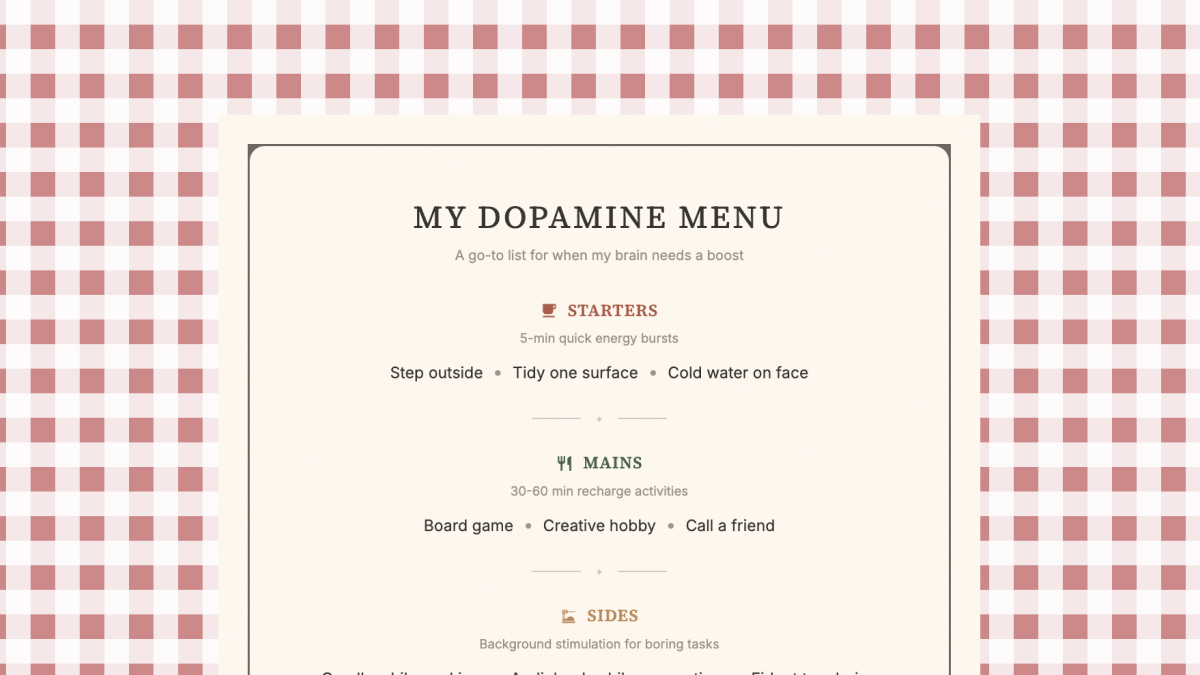
Pre-decide. The worst time to figure out what to do is when you're already bored and your brain has gone offline. Tools like a dopamine menu (a personalised list of activities sorted by effort level) work because you built them when your brain was functioning and use them when it isn't. The hard work of generating options happens in advance.

Try the Dopamine Menu
Build a personalised list of feel-good activities sorted by effort level. When you're stuck, it suggests one for you. Free, no account needed.
Start this toolStart absurdly small. Don't aim for the activity. Aim for the first 30 seconds of the activity. Put on one song. Open the book to any page. Step outside and stand there. You're not committing to anything. You're creating a micro-shift in dopamine that might make the next step possible.
Change one sensory input. Move to a different room. Open a window. Put on music. Change your clothes. ADHD brains respond to novelty, and sometimes a small environmental shift is enough to break the flatness.
Use a body-first approach. When your brain won't cooperate, start with your body instead. Stretch. Splash cold water on your face. Chew something crunchy. Physical sensation can bypass the cognitive block and create just enough activation to think again.
Name it. Sometimes just recognising "this is ADHD boredom, not me being broken" takes the edge off. The shame spiral (why can't I just do something, what's wrong with me) makes the freeze worse. Recognising the pattern interrupts it.
When boredom signals something deeper
Occasional ADHD boredom is part of the condition. But if nothing has sounded fun for weeks, if the flatness has spread into things you used to love, or if you're finding it hard to care about anything at all, that may be more than boredom.
ADHD and depression frequently co-occur. Chronic understimulation can also contribute to burnout, particularly for people who've been masking heavily. If the pattern feels persistent rather than situational, it's worth speaking with a professional who understands ADHD. Not to pathologise boredom, but to make sure something else isn't going on underneath it.
The goal isn't to eliminate boredom. ADHD brains will always run into moments where nothing sounds good. The goal is to have something ready for those moments, so you're not stuck trying to generate ideas from an empty tank.
Tools mentioned in this article
Common questions
ADHD boredom isn't about having nothing to do. It's about nothing generating enough dopamine to feel engaging. You can have a full schedule and still feel profoundly bored because none of it activates your interest-based nervous system.
They can look similar but feel different. ADHD boredom is restless and frustrated: you want to do something, you just can't find what. Depression tends to feel flat and withdrawn, with reduced desire to do anything at all. They also frequently co-occur, which makes it harder to untangle.
Researchers believe this is related to how ADHD brains process understimulation. Some studies describe it as an aversive internal state that the brain treats similarly to physical discomfort. You're not being dramatic. It genuinely feels bad.
It can. Stimulant medication increases dopamine availability, which can raise your baseline interest in everyday activities. But medication alone rarely eliminates the pattern. Building strategies alongside it tends to work better.
Sources & references
- Dodson, W. (2023). The Interest-Based Nervous System. ADDitude Magazine.
- Volkow, N.D., et al. (2009). Evaluating Dopamine Reward Pathway in ADHD. JAMA, 302(10), 1084-1091.
- Barkley, R.A. (2015). Attention-Deficit Hyperactivity Disorder: A Handbook for Diagnosis and Treatment (4th ed.). Guilford Press.
- Eastwood, J.D., et al. (2012). The Unengaged Mind: Defining Boredom in Terms of Attention. Perspectives on Psychological Science, 7(5), 482-495.