Get startedTakes 5-10 minutes · Your data stays on your device
Build your menu
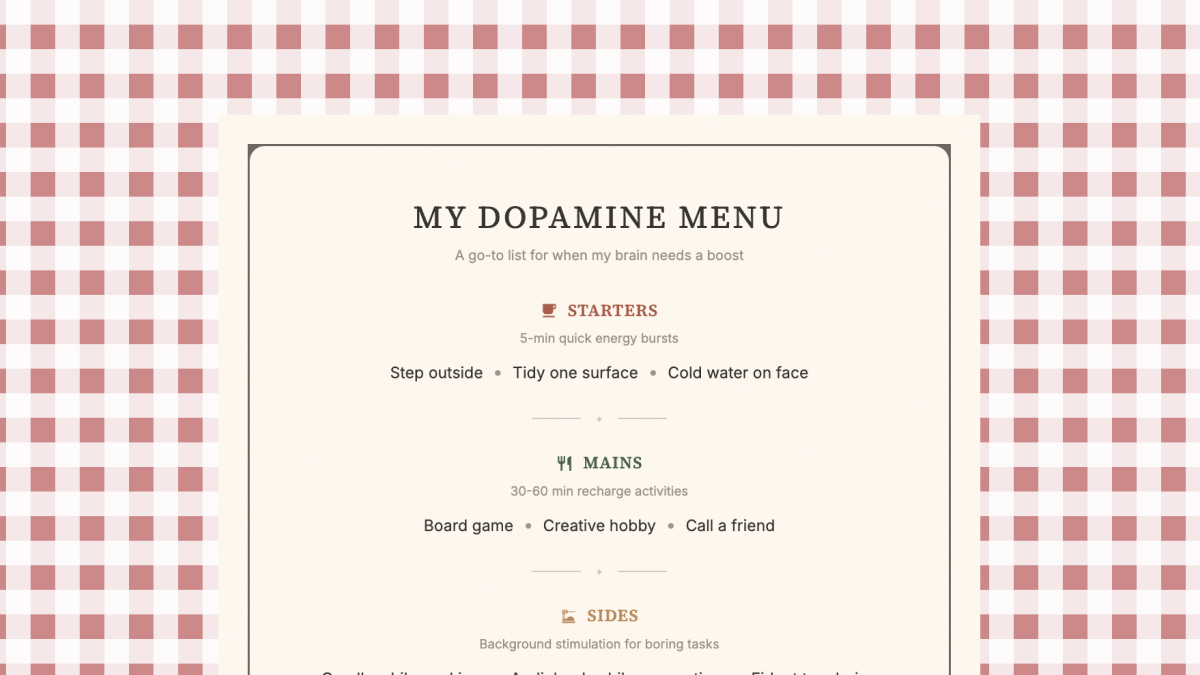
Choose activities across 5 categories based on time and energy: Starters (quick hits), Mains (deeper recharge), Sides (background stimulation), Desserts (high-reward treats), and Specials (things worth planning for)
Get your menu card
Download a restaurant-style menu card you can save to your phone, print, or share
Use rescue mode
When you're stuck, return and tap "I'm stuck right now" to get a single suggestion based on how much time you have
A dopamine menu is a personalised list of activities that help your brain get unstuck. Unlike a to-do list (obligations), a dopamine menu is about options (things you've pre-selected that actually help). The restaurant metaphor isn't decorative: it's functional framing. You're building a menu you can order from when decision-making feels impossible.
The concept was popularised by Jessica McCabe of How to ADHD and draws on behavioural activation, a clinically validated intervention for depression and low motivation. The idea is simple: when your brain is depleted, it can't generate options. But it can recognise options from a list you made earlier.
This tool organises activities into five categories based on effort and duration:
What makes this version different is the rescue mode. Most dopamine menu tools stop at building the menu. This one also helps you use it: when you're stuck, you tap one button, tell us how much time you have, and get a single suggestion. No browsing, no deciding. Just one thing to try.
This tool is for anyone who experiences decision paralysis, low motivation, or the "I know I should do something but I can't think of anything" feeling. That includes people with ADHD, depression, burnout, or chronic fatigue. You don't need a diagnosis to benefit from having a pre-built list of options for depleted moments.
It's especially useful if you've tried generic activity lists and found they don't stick. The menu is yours: built from your preferences, not someone else's idea of self-care.
The dopamine menu is grounded in research on ADHD, motivation, and decision-making. PET imaging studies by Volkow and colleagues (2009) found that adults with ADHD have significantly lower dopamine receptor availability in reward pathways, creating a chronic motivation deficit.
Russell Barkley's executive function model identifies impaired self-motivation as a core feature of ADHD: the inability to internally generate motivation without immediate external reinforcement. The dopamine menu functions as an external scaffold for the self-motivation system, pre-loading rewarding options so the depleted brain doesn't have to generate them from scratch.
Research on decision paralysis in ADHD found that 82% of adults report frequent decision-making difficulties, and 35% experience decision paralysis daily. The menu framework leverages choice architecture principles from Thaler and Sunstein's work: categorising options by effort level and duration reduces cognitive strain.
The tool also addresses delay aversion, a core feature of ADHD's dual pathway model. Meta-analysis by Marx et al. (2021) confirms that people with ADHD choose small immediate rewards over large delayed ones at significantly higher rates. The dopamine menu eliminates delay by providing immediate access to pre-vetted activities.
Dr Robert Wilfahrt at Mayo Clinic describes the dopamine menu as "a rebranding of what psychologists previously called behavioural activation: ways to get yourself to do what's best for you, instead of what you feel like doing in the moment."
A to-do list is about obligations. A dopamine menu is about options you've chosen that help your brain get unstuck. You're not tracking completion or building habits. You're building a rescue kit for when decision-making feels impossible.
Try one Starter from the suggestions we provide: step outside for 60 seconds, play your favourite song, or splash cold water on your face. Even without a full menu, those quick hits can create enough movement to get unstuck. Build your menu when you have more capacity.
No. Everything on your menu is okay to choose. Desserts are high-reward activities that can tip into overconsumption (social media, video games, comfort food). The menu frames them with awareness, not guilt. Many people add guardrails like 'one episode' or '20 minutes' to help them stop naturally.
That's valuable information. If nothing appeals, you might be dealing with sleep debt, burnout, depression, or sensory overload: issues beyond what a menu can solve. It might be time to rest, or to talk to a professional. The menu works for everyday stuck moments, not crisis states.
Whenever something stops working. Activities lose their dopamine punch over time (novelty decay). If you find yourself skipping over certain items repeatedly, swap them out. The menu should feel alive and current, not like homework from six months ago.
Yes. You can skip any category, even all of them. There's no pressure to complete every section. Some people don't need Specials. Some people have lots of Starters and no Desserts. Build what works for you.