ADHD Impulse Spending: Causes and What Helps
ADHD impulse spending affects 48% of adults with ADHD. Learn why it happens, what it really costs, and strategies that work with your brain.
Impulse spending is one of the biggest contributors to the ADHD tax, and one of the most misunderstood. It's not about lacking self-control or being bad with money. It's how ADHD brains are wired: seek reward, struggle with the pause between wanting and doing.
Why ADHD brains impulse spend
The ADHD brain is chronically under-stimulated. Dopamine, the neurotransmitter that drives motivation and reward, operates differently in ADHD. When your baseline dopamine is low, your brain looks for quick hits wherever it can find them. Buying something new delivers that hit reliably and immediately.
Russell Barkley's research on executive function explains the rest. The prefrontal cortex, responsible for impulse control and weighing future consequences, works differently in ADHD. The gap between "I want this" and "I bought this" is shorter. The future consequences (credit card bill, regret, clutter) feel abstract and distant. The dopamine hit feels concrete and now.
This is neurology, not character. And understanding that changes which strategies actually work.
The real cost of impulse spending
A June 2022 Monzo and YouGov survey found that 48% of UK adults with ADHD impulse spend regularly, compared to just 12% of neurotypical adults. That's four times the rate.
The individual purchases often seem small. £15 here, £30 there. But they compound. A £20 impulse buy twice a week is over £2,000 a year. Add the subscription you signed up for impulsively and forgot to cancel, the hobby supplies for the hobby you never started, the "treat yourself" purchases that felt urgent at 11pm. The annual total grows quickly.
This is part of what researchers call the "ADHD tax": the hidden cost of living with a neurological condition in a world designed for neurotypical brains. Impulse spending is often the biggest single category.
What doesn't work
Willpower. ADHD is an executive function condition. Telling yourself to "just resist" is asking your prefrontal cortex to do exactly what it struggles with. You might succeed sometimes, but it's exhausting and unsustainable.
Guilt. Shame triggers avoidance. The worse you feel about spending, the less likely you are to look at your accounts. Less visibility means more spending.
Deleting shopping apps. Helps temporarily, but doesn't address the underlying need for stimulation. You'll find another way to get the dopamine hit, or you'll reinstall the app at 2am.
These strategies fail because they fight against your neurology instead of working with it.
Strategies that work with your brain
The ADHD-adapted 24-hour rule
The standard advice is to wait 24 hours before buying. For ADHD brains, this needs adjustment. The goal isn't to wait; it's to create friction. Add the item to a wish list. Screenshot it. Put it in a "maybe" folder. The act of capturing it satisfies some of the urge without completing the purchase. Many items never make it past this stage.
Designated "fun money"
Rather than trying to eliminate impulse spending entirely (which creates restriction/binge cycles), budget for it explicitly. A set amount each month that's yours to spend impulsively, no guilt. When it's gone, it's gone. This works because it removes the shame while adding a natural limit.
Environment design
Remove saved payment methods from shopping sites. Unsubscribe from marketing emails. Turn off notifications from shopping apps. Make the path from "I want this" to "I bought this" longer and more effortful. ADHD brains follow the path of least resistance. Design your environment so that path doesn't lead to checkout.
Body doubling for big purchases
Before buying anything over a certain amount (pick your threshold: £50, £100), tell someone. Text a friend, message your partner, post in an ADHD support group. The act of externalising the decision adds a pause and often provides perspective. Many impulse purchases don't survive being said out loud.
Wish list friction
Keep a running wish list, but add a rule: items must sit on the list for a set time (a week, a month) before you can buy them. Review the list periodically. You'll be surprised how many things no longer appeal after the initial dopamine surge passes.
Calculate what impulse spending is costing you
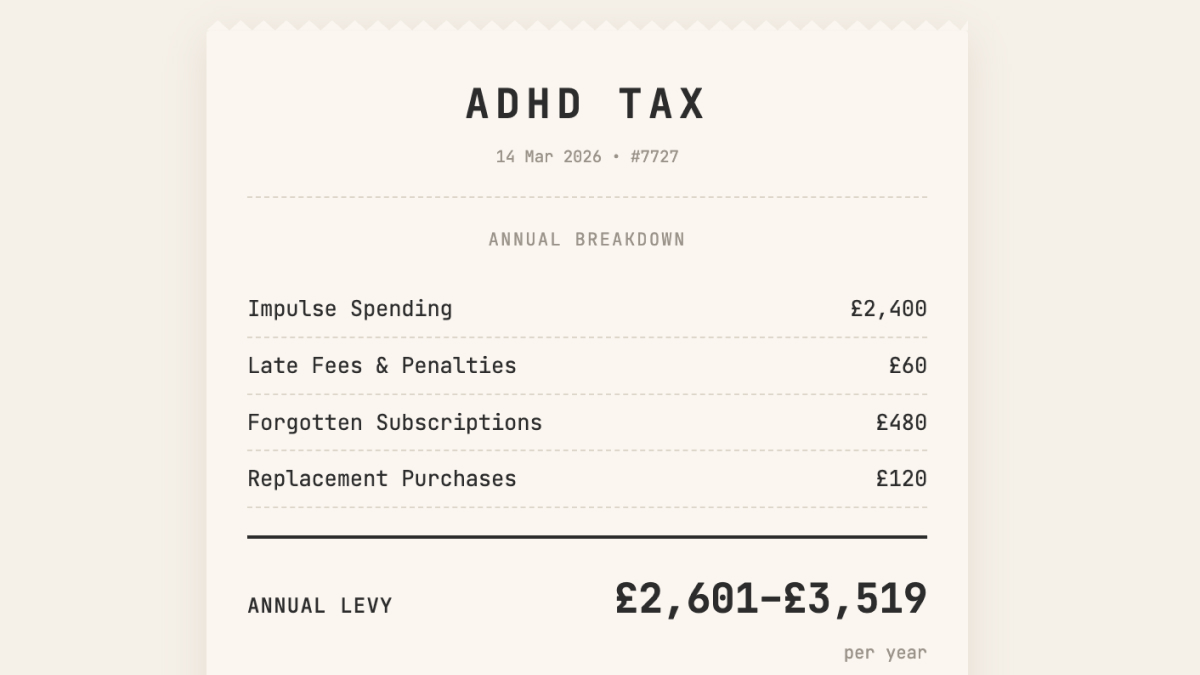
Most people underestimate their impulse spending because they don't add it up. The ADHD Tax Calculator helps you see the annual picture. Not to create guilt, but to see clearly. Once you know the number, you can decide what to do with it.
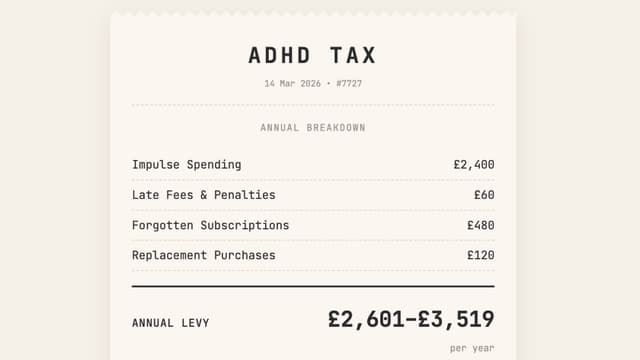
Try the ADHD Tax Calculator
See how impulse spending fits into your total ADHD tax. Takes 3-4 minutes.
Start this toolIf impulse spending turns out to be your biggest ADHD tax category, that's useful information. It tells you where to focus. And if it's lower than you expected, that's worth knowing too.
Tools mentioned in this article
Common questions
Research shows 48% of people with ADHD impulse spend regularly, compared to 12% of neurotypical adults. ADHD impulse buying is a neurology thing, not a character flaw.
Impulse spending is driven by dopamine-seeking and executive function differences, not willpower. Strategies need to work with your brain, not against it.
Most people underestimate. The ADHD Tax Calculator can help you see the annual total.
Sources & references
- Monzo/YouGov (2022). The Extra Costs of Living with ADHD. Published 27 June 2022.
- Barkley, R. A. (2012). Executive Functions: What They Are, How They Work, and Why They Evolved. Guilford Press.