ADHD Tax Calculator
Answer 6 quick questions. Get a personalised estimate of your annual ADHD tax in money, time, and energy.
Get startedTakes 3-4 minutes · Your data stays on your device
Answer 6 quick questions. Get a personalised estimate of your annual ADHD tax in money, time, and energy.
Answer 6 questions
Quick frequency-based questions, no exact figures needed
Watch your total build
See the running total update as you answer
Get your receipt
A personalised breakdown of your annual ADHD tax
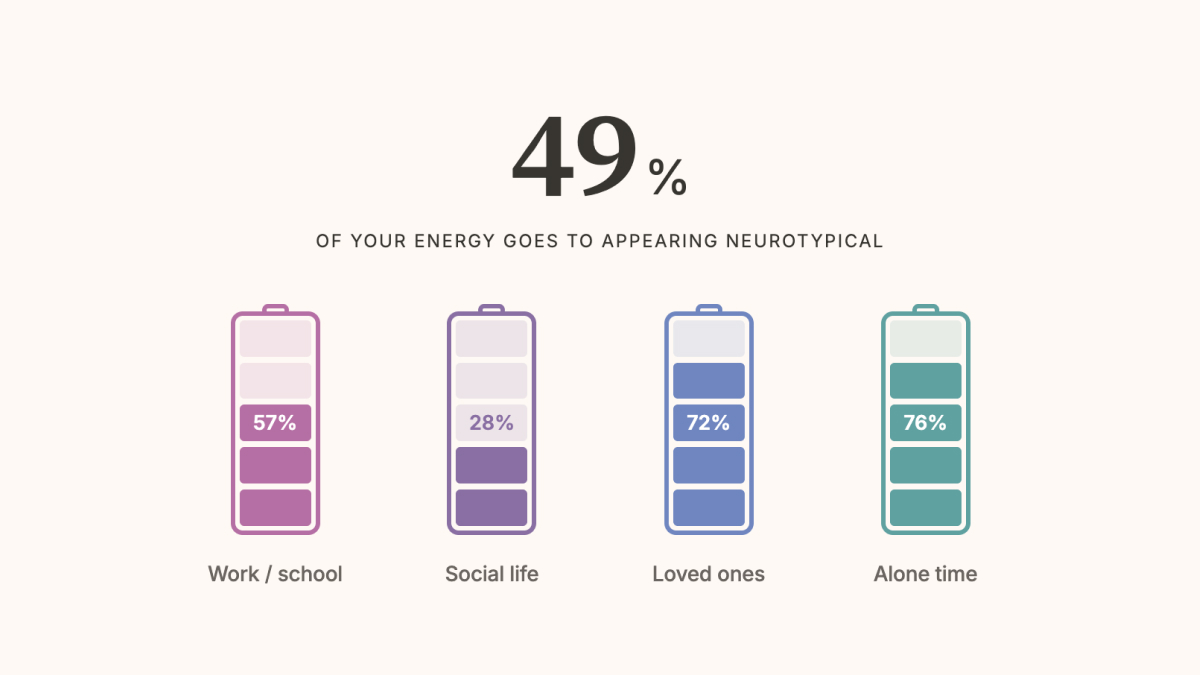
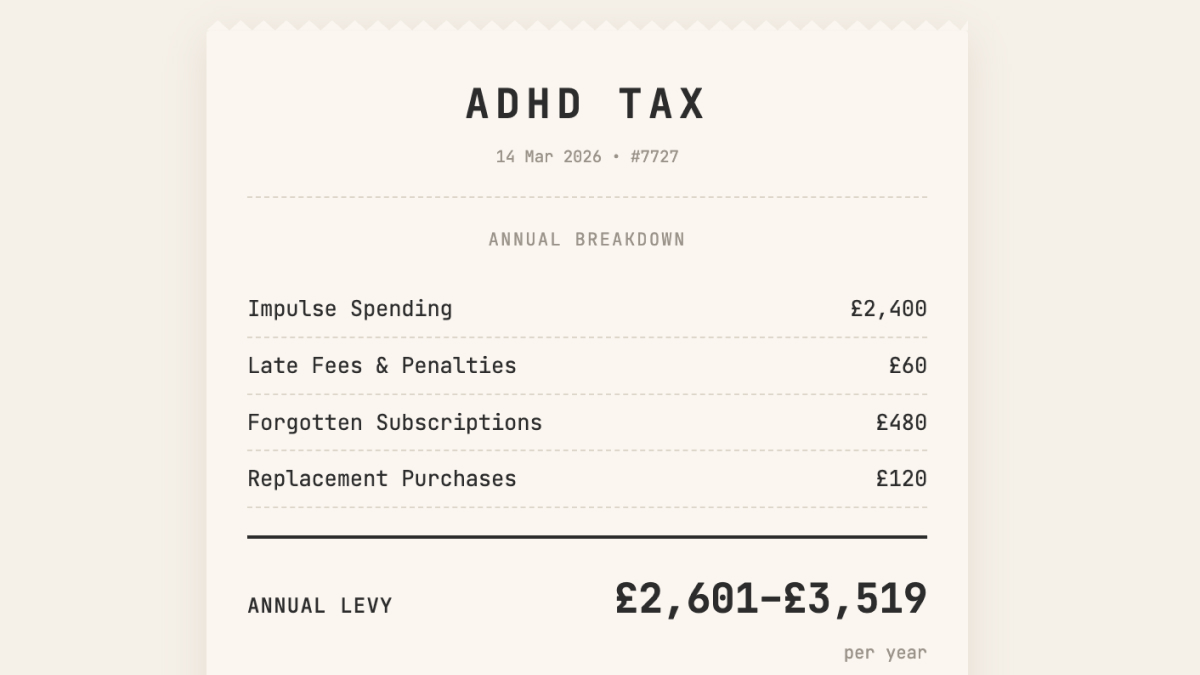
The ADHD Tax Calculator estimates the hidden costs of living with ADHD: the money spent on impulse purchases, late fees, forgotten subscriptions, and replacement items; the hours lost to searching, re-doing, and task-switching; and the energy drained by constant compensating.
This isn't about blame. ADHD affects how your brain manages money, time, and energy. The "ADHD tax" is what you pay for living in a world designed for neurotypical brains.
The tool uses UK survey data and reasonable estimates to convert your frequency selections into annual costs. You don't need bank statements or exact figures. Ballpark answers work fine. The result is a range, not a precise figure, because honest estimation beats false precision.
This tool is for UK adults with ADHD (diagnosed or self-identified) who want to understand the real cost of their condition. It's also useful for ADHD coaches assigning reflection exercises, and for anyone curious about the invisible price they're paying.
No. Frequency estimates work fine. 'Monthly' vs 'weekly' is enough. The tool converts these to annual costs using UK averages.
Yes. Any question can be skipped and won't be included in your total. The result is still valid.
Because estimation-based tools shouldn't imply accounting-grade precision. The range reflects the uncertainty in frequency-based estimates.
Time spent searching for things, re-doing tasks, recovering from distractions, and switching between tasks. The overhead of ADHD, not the tasks themselves.
Energy drain is real but hard to monetise fairly. A stay-at-home parent's lost energy isn't worth £0. We show it as a battery level instead.
The term "ADHD tax" emerged from the ADHD community to describe the hidden costs of living with a neurological condition in a world designed for neurotypical brains. A June 2022 Monzo and YouGov survey of UK adults with ADHD found the average person pays approximately £1,600 per year in direct financial costs: from impulse purchases and late fees to forgotten subscriptions and replacement items.
This isn't about willpower or character. Research by Russell Barkley shows that ADHD fundamentally affects executive function: the brain's ability to plan, prioritise, and regulate behaviour. When your working memory struggles to hold financial deadlines or your impulse control is neurologically compromised, costs accumulate. Thomas Brown's work on ADHD executive function deficits explains why time blindness leads to late fees and why emotional dysregulation drives comfort spending.
The frequency-based estimation approach works particularly well for ADHD brains. Rather than asking for exact figures (which requires precise recall that ADHD working memory struggles with), frequency questions like "monthly" vs "weekly" reduce cognitive load while still producing meaningful estimates. The result is a range, not a precise figure, because honest estimation beats false precision.