ADHD Reward Systems That Actually Work
Most reward systems fail ADHD brains. Learn why, and discover approaches like dopamine menus that work with your neurology instead of against it.
You've tried the sticker chart. The habit tracker. The "if I finish this report, I can watch TV" deal. And it worked for about three days before your brain decided the reward wasn't interesting enough, the task wasn't urgent enough, and the whole system quietly collapsed.
This isn't a willpower failure. Most reward systems are built for brains that process rewards differently than yours.
Why traditional reward systems fail ADHD brains
Standard reward systems rely on a simple mechanism: connect an unpleasant task to a future pleasant outcome, and motivation bridges the gap. Finish your homework, get screen time. Hit the sales target, get the bonus. This works when your brain reliably values future rewards.
ADHD brains don't. Research by Sonuga-Barke (2005) identified what's called a steep delay-discounting curve in ADHD: the further away a reward is, the faster it loses motivational power. A reward available in 30 seconds is compelling. The same reward available in 30 minutes is nearly irrelevant. By next week, it might as well not exist.
This explains why every "treat yourself on Friday if you do X all week" system collapses by Wednesday. Your brain isn't being difficult. It's processing time differently at a neurological level.
There's a second problem: habituation. ADHD brains adapt to rewards quickly. Sagvolden et al. (2005) described this as a steeper reinforcement gradient, meaning the same reward loses its motivational power faster. That coffee shop visit that motivated you last week? Your brain has already filed it as boring. The reward system demands constant novelty to keep working.
What works instead
The reward systems that survive ADHD share a few common features: rewards are immediate or near-immediate, varied enough to resist habituation, and low-friction enough that setting them up doesn't become its own executive function burden.
Pair, don't postpone
Instead of "finish the task, then get the reward," try doing both at once. Listen to a podcast while cleaning. Work from a café instead of your desk. Put on a show you're into while folding laundry.
This is called temptation bundling, and it sidesteps the delay-discounting problem entirely. The reward isn't waiting at the end. It's happening alongside the task. Your brain doesn't need to bridge a motivational gap because there isn't one.
The key is matching the reward to the task. Passive tasks pair well with engaging audio or visual input. Tasks requiring focus pair better with environmental rewards: a nicer location, a good drink, a comfortable chair.
Use a menu, not a single reward
One fixed reward habituates quickly. A rotating set of options stays fresh longer.
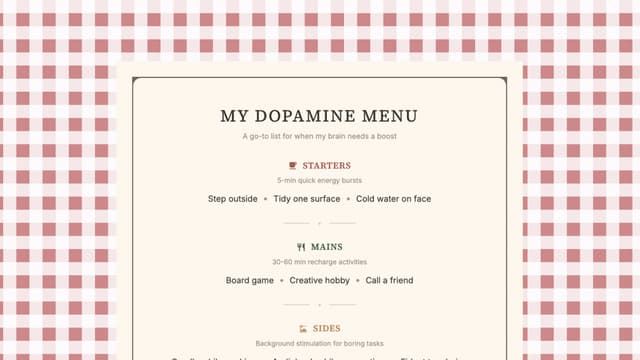
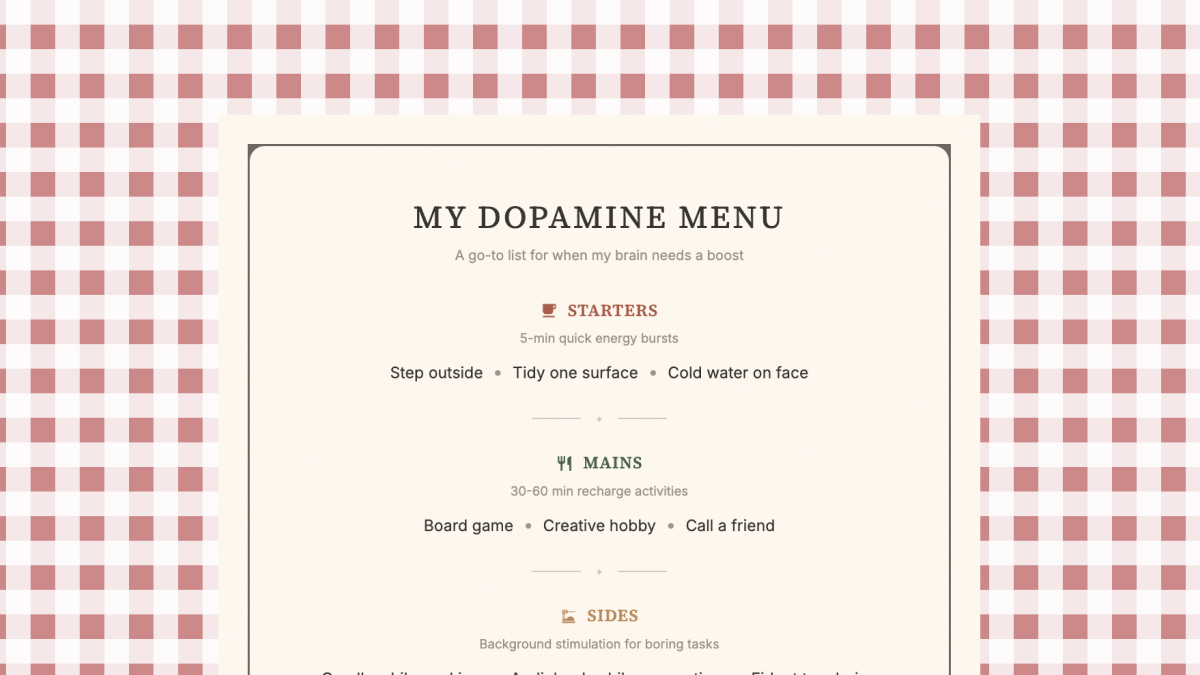
This is where a dopamine menu becomes useful as a reward system. Instead of "I'll get a coffee if I finish this," you consult a pre-built list of enjoyable activities and pick whatever appeals in the moment. The variety protects against habituation. The pre-built list removes the executive function cost of generating ideas.
Try the Dopamine Menu
Build a personalised menu of feel-good activities sorted by effort level. Use it as a reward system, a boredom toolkit, or both. Free, no account needed.
Start this toolMake rewards immediate and visible
Physical tokens work surprisingly well for some ADHD adults. Moving a marble from one jar to another. Ticking a box with a satisfying pen. Placing a coin in a jar. These create an immediate, tangible, sensory signal that something was accomplished.
The token itself isn't the real reward. The visual progress is. Watching a jar fill up or a row of checkmarks grow provides ongoing micro-hits of satisfaction rather than a single delayed payoff.
Shrink the task, not the reward
If a task feels too large to start, making the reward bigger doesn't help. Making the task smaller does. "Write the report" becomes "open the document." "Clean the kitchen" becomes "clear the sink." Pair the tiny task with an immediate reward and you've created a loop your brain can actually engage with.
Over time, the loop often extends naturally. You opened the document and wrote a sentence. Then a paragraph. Then you forgot you were supposed to stop. This isn't discipline. It's momentum, which ADHD brains can sustain even when they struggle to initiate.
The systems that survive
The ADHD reward systems that last more than a week tend to have three things in common:
Low setup cost. If maintaining the system requires daily planning, tracking, or decision-making, it becomes another task to avoid. The best systems run with minimal overhead.
Built-in variety. A single reward gets stale. A rotating menu or a selection of options keeps things interesting enough that your brain doesn't tune out.
Forgiveness for gaps. Any system that collapses when you miss a day isn't built for ADHD. The best reward systems are easy to pick back up after you inevitably forget about them for a while.
Perfectionism is the enemy here. A messy, inconsistent reward system that you actually use beats an elaborate one that lives in a spreadsheet you opened twice. Start with something simple (pair one boring task with one enjoyable activity today) and iterate from there.
Tools mentioned in this article
Common questions
Most reward systems rely on delayed gratification: do the hard thing now, get the reward later. ADHD brains discount future rewards steeply, meaning a reward next week barely registers compared to something available right now. The system collapses before it builds momentum.
If it helps you do them, yes. There's no minimum threshold of difficulty that qualifies for a reward. If pairing a boring task with something enjoyable gets it done, that's not cheating. That's working with your brain.
No. Behavioural strategies and medication address different aspects of ADHD. Medication increases dopamine availability at a neurochemical level. Reward systems help you structure your environment and routines. Most people benefit from both, but they're not interchangeable.
A reward system ties enjoyable activities to task completion: finish the task, earn the reward. A dopamine menu is a standalone tool for when you're stuck or bored, with no task attached. They complement each other well.
Sources & references
- Sonuga-Barke, E. (2005). Causal models of ADHD: from common simple deficits to multiple developmental pathways. Biological Psychiatry, 57(11), 1231-1238.
- Sagvolden, T., et al. (2005). A dynamic developmental theory of ADHD. Behavioral and Brain Sciences, 28(3), 397-419.
- Dodson, W. (2023). The Interest-Based Nervous System. ADDitude Magazine.
- Barkley, R.A. (2012). Executive Functions: What They Are, How They Work, and Why They Evolved. Guilford Press.