ADHD Tax: Real Cost Data (UK & Global)
How much does the ADHD tax really cost? Verified UK and global research, what's real, what's projection, and what we don't know yet.
The numbers on ADHD tax costs vary wildly depending on where you look. £1,600 per year. $1.27 million lifetime. £17 billion national burden. These figures get cited without context, mixed together, and sometimes misattributed. Here's what the research actually shows, and what we don't yet know.
The UK headline: £1,600/year
The most-cited UK figure comes from a Monzo and YouGov survey published in June 2022. The survey asked 506 UK adults with self-reported ADHD to estimate their extra annual costs, with 2,068 adults completing a comparison survey.
The findings paint a clear picture of financial strain:
| Measure | ADHD group | Non-ADHD group |
|---|---|---|
| Estimated extra annual cost | £1,600 | n/a |
| Frequent impulse spending | 48% | 12% |
| Missed bill payments | 49% | 18% |
| Struggle with debt | 31% | 11% |
| Difficulty sticking to budget | 50% | 15% |
Monzo extrapolated this to estimate £1.74 billion in annual costs across 1.8 million UK adults with ADHD.
Important caveats: This was a survey, not tracked financial data. ADHD was self-reported without clinical verification. The £1,600 is participants' own estimates of extra spending. Monzo published the results alongside marketing for their app features, creating a commercial interest. The survey also doesn't break down the £1,600 into specific categories (late fees = £X, impulse spending = £Y); it only reports behavioural prevalence rates.
This doesn't invalidate the findings. YouGov is a credible polling firm, and the sample size is reasonable. But the figure should be understood as a self-reported estimate, not a clinical measurement.
The strongest evidence: Swedish population data
The most rigorous research on ADHD and finances comes from Scandinavian countries, where population registries allow researchers to track entire national populations using objective records rather than self-report.
6x higher default risk by age 40
A landmark 2020 study in Science Advances (Beauchaine et al.) used the entire Swedish population (11.55 million people) linked with objective credit data. By age 40, individuals with ADHD had over 6 times the default risk of the general population, with higher rates of missed payments across every category of financial obligation.
This matters because it's not survey data. It's every adult in Sweden, with clinical ADHD diagnoses from national health registers, linked to actual credit records. The study also found that financial distress was associated with 4 times higher suicide risk among those with ADHD. Notably, ADHD medication was not associated with improved financial behaviours.
17% lower annual income
A 2021 study in PLoS ONE (Jangmo et al.) followed 1.2 million Swedes from school graduation for up to 16 years. Those with clinically diagnosed ADHD earned 17% less annually, had 12 more days of unemployment per year, and were 19 times more likely to receive disability pension.
Population-level register data like this eliminates the selection bias and self-report problems that limit other studies. The limitation: Swedish labour markets and social safety nets differ from the UK. But for understanding the underlying relationship between ADHD and financial outcomes, this is as close to gold-standard evidence as exists.
Lifetime cost projections
The often-cited "$1.27 million lifetime earnings difference" comes from a 2020 study in the Journal of Consulting and Clinical Psychology (Pelham et al.). Researchers followed 364 children rigorously diagnosed with ADHD in Pittsburgh, plus 240 controls, for approximately 20 years.
At age 30, the ADHD group earned 37% less per month (~$2,211 vs $3,530), had 66% less in savings ($3,990 vs $11,780), and only 20% had saved for retirement versus 42% of controls. Extrapolating these early-career gaps to retirement produced the $1.27 million figure.
Critical caveats often omitted: This is a projection, not observed lifetime data. It extrapolates from age 25-30 income. It applies only to males (the female sample was too small). The sample may overrepresent severe cases: 47% had comorbid ODD, 36% had conduct disorder. And it's US data from one county in Pennsylvania.
Still, this remains the best longitudinal data we have on ADHD and lifetime financial outcomes.
The bigger picture: societal costs
United States: $122.8 billion
A 2022 analysis in the Journal of Managed Care & Specialty Pharmacy (Schein et al.) estimated the total US societal cost of adult ADHD at $122.8 billion annually ($14,092 per adult). The breakdown:
| Category | Cost | Share |
|---|---|---|
| Unemployment | $66.8B | 54% |
| Productivity loss | $28.8B | 23% |
| Healthcare | $14.3B | 12% |
| Caregiving | $6.6B | ~5% |
| Premature mortality | $3.2B | ~3% |
Funding disclosure: Lead author Jeff Schein is employed by Otsuka Pharmaceutical (maker of ADHD medication Qelbree), and co-authors from Analysis Group were paid consultants. This doesn't invalidate peer-reviewed findings, but worth knowing.
United Kingdom: £17 billion
The NHS Independent ADHD Taskforce (2025) estimates annual UK costs at £17 billion. This figure was extrapolated from a Danish sibling study (Daley et al., 2019), which found approximately €20,134 (~£17,000) in additional annual costs per adult with ADHD compared to their same-sex sibling. The Taskforce applied this per-person cost to UK population estimates.
No direct UK cost study was conducted. The Taskforce itself acknowledges: "No published papers on the contemporary costs of untreated ADHD in the UK exist yet."
What we don't know (yet)
Being honest about gaps matters more than citing impressive-sounding numbers:
No UK peer-reviewed study on ADHD and earnings exists. The NHS Taskforce explicitly states this. Everything we know about UK costs is either survey data (Monzo) or extrapolated from Scandinavian research.
No study anywhere quantifies ADHD costs by category. Despite common references to specific costs for late fees, impulse spending, or food waste, no academic research has actually measured these. The categories are clinically plausible and anecdotally well-documented, but the evidence base is behavioural prevalence, not pounds per category.
Industry funding is pervasive. The largest economic burden studies (both the $122.8 billion US estimate and earlier $143-266 billion estimates) were funded by ADHD pharmaceutical manufacturers. This doesn't make them wrong, but it should inform how definitively we cite them.
Self-reported data differs dramatically from register data. Survey participants estimating their own costs produce different numbers than population-level analysis of actual financial records. Both have value. Neither tells the complete story.
Why averages don't tell your story
Research gives us population averages. But ADHD affects different people differently. Your ADHD tax depends on your specific patterns: whether impulse spending, late fees, forgotten subscriptions, or lost time is your biggest drain.
Averages also obscure range. Some people with ADHD have developed systems that keep their costs low. Others, particularly those diagnosed late or without support, pay significantly more than any average suggests.
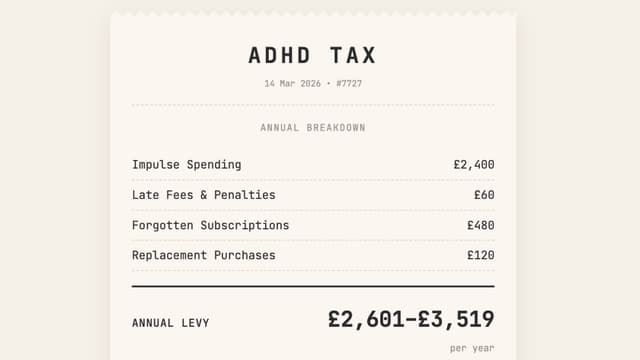
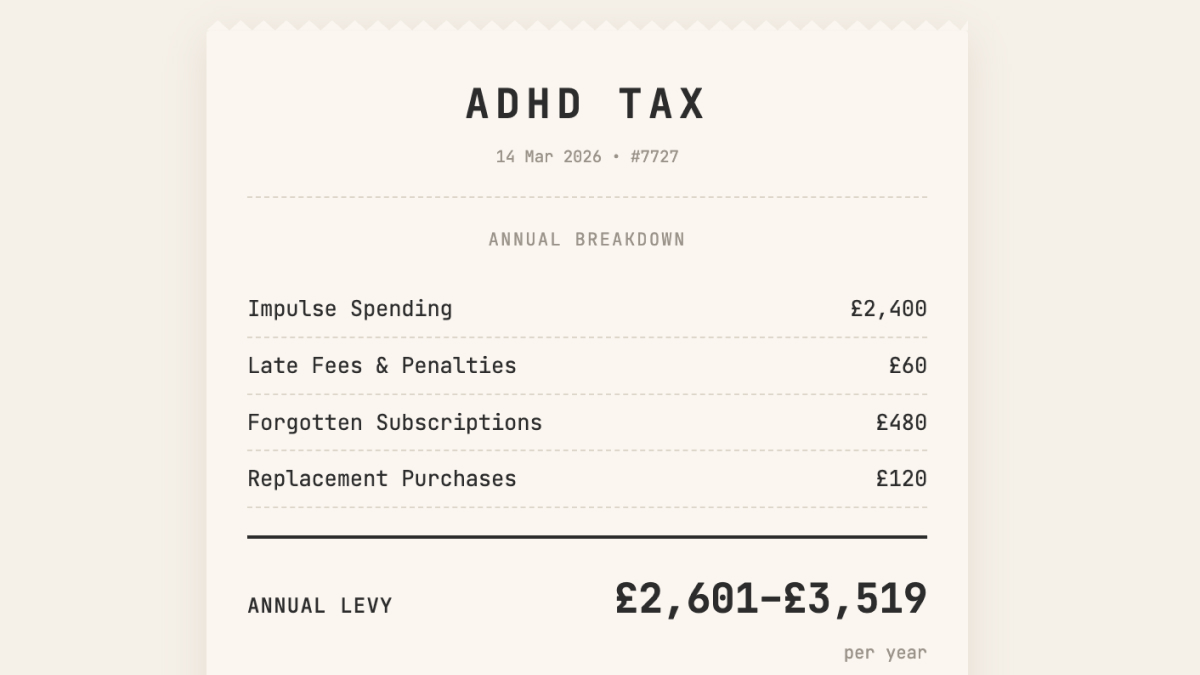
Try the ADHD Tax Calculator
Calculate your personal ADHD tax based on your actual patterns. Takes 3-4 minutes.
Start this toolThe research tells us that ADHD has real financial costs. What it can't tell you is what those costs look like in your life. That requires looking at your own patterns. Not to create guilt, but to see clearly, so you can decide what, if anything, to do about it.
Tools mentioned in this article
Common questions
A June 2022 Monzo/YouGov survey of 506 UK adults with self-reported ADHD. It's their estimate of extra annual costs, not tracked spending data.
Not yet. The NHS ADHD Taskforce (2025) explicitly notes no UK studies exist. The best earnings data comes from Swedish population registries.
Studies use different methodologies, populations, and definitions. US figures don't translate directly to UK. Projections differ from observed data.
Sources & references
- Monzo/YouGov (2022). The Extra Costs of Living with ADHD. Published 27 June 2022.
- Beauchaine TP, Ben-David I, Bos M. (2020). ADHD, financial distress, and suicide in adulthood. Science Advances, 6(40): eaba1551.
- Jangmo A et al. (2021). ADHD and occupational outcomes. PLoS ONE, 16(3): e0247724.
- Pelham WE III et al. (2020). Long-term financial outcome of children diagnosed with ADHD. Journal of Consulting and Clinical Psychology, 88(2): 160-171.
- Daley D et al. (2019). Economic burden of adult ADHD: A sibling comparison. European Psychiatry, 61: 41-48.
- Schein J et al. (2022). Economic burden of ADHD among adults in the US. Journal of Managed Care & Specialty Pharmacy, 28(2): 168-179.
- NHS England (2025). Report of the Independent ADHD Taskforce: Part 1.