How to Make a Dopamine Menu (Step-by-Step)
How to make a dopamine menu in 4 steps: brain-dump, sort by effort, fill the gaps, and keep it where you'll see it. Built for ADHD adults.
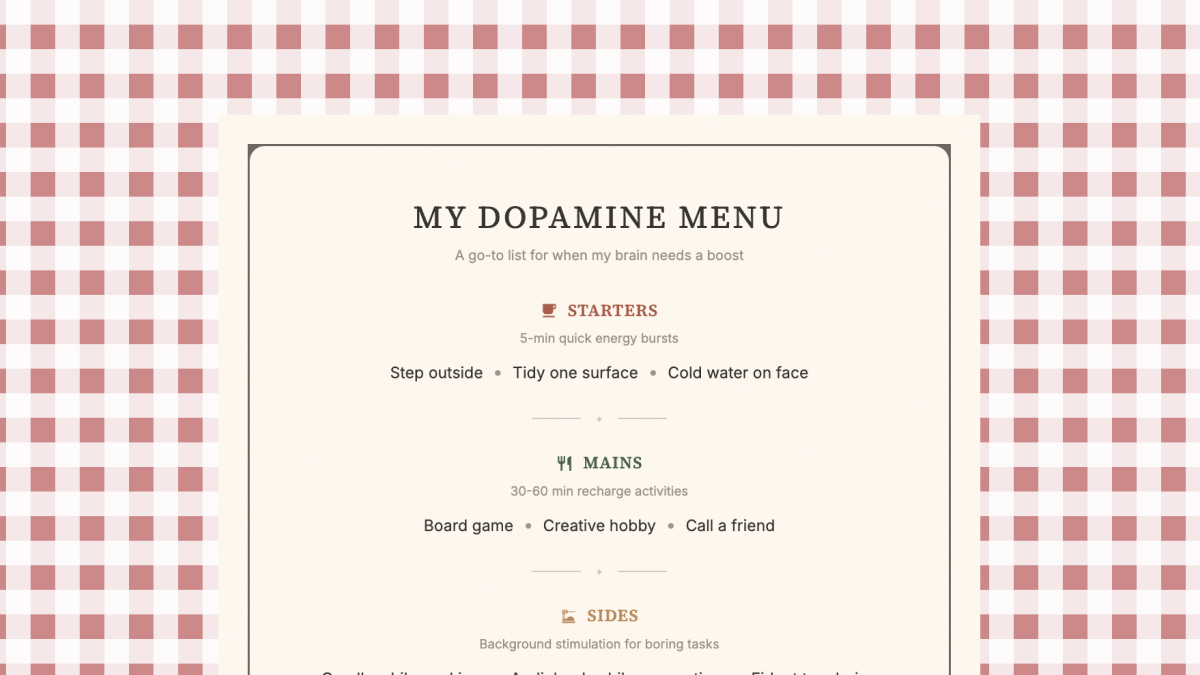
A dopamine menu is a personalised list of activities that feel good, sorted by how much effort they take. You build it when your brain is working so you can use it when it isn't: those moments where you're stuck, understimulated, and completely unable to think of a single thing you want to do.
Here's how to make one that you'll actually use.
Step 1: Brain-dump everything that feels good
Set a timer for 10 minutes. Write down every activity that has ever made you feel even slightly better. Don't filter, don't judge, don't organise. Just list.
Include the obvious things (walking, cooking, gaming) but also the small, weird, specific things that only you would think of. Lying on the kitchen floor. Watching one particular YouTube channel. Reorganising your spice rack. Smelling coffee without drinking it.
If you're struggling to think of anything, try these prompts:
- What did you do last time you felt genuinely absorbed in something?
- What's the first thing you do when you're home alone with no obligations?
- What did you enjoy as a child that you've stopped doing?
- What do you do when you're procrastinating? (That's dopamine-seeking. It counts.)
Don't worry about whether activities are "productive" or "healthy." A dopamine menu isn't a self-improvement plan. It's an honest record of what actually works for your brain.
Step 2: Sort by effort level
Now take your list and sort each item into one of five categories:
Starters: almost zero effort. Things you can do from the sofa, in under five minutes, without any preparation. These are your emergency options for when initiation feels impossible.
Mains: medium effort. Activities that require some energy to start but sustain themselves once you're going. A walk, cooking, a hobby session, a game.
Sides: social or sensory. Things that shift your mood through connection or physical sensation. Music, texting a friend, a hot shower, changing your environment.
Desserts: treats. Bigger rewards you save for when you need a proper boost. A favourite takeaway, a new book, an afternoon off.
Specials: rare, high-investment experiences. A day trip, a concert, trying a new class. These go on the menu so you remember they exist.
The most important distinction is between Starters and everything else. On your worst days, Starters are the only category you'll be able to access. Make sure you have at least five or six of them, and make sure they're genuinely low-friction: not activities that sound easy but actually require you to get dressed, leave the house, or find equipment.
Step 3: Fill the gaps
Look at your sorted menu. Most people find they have plenty of Mains and Desserts but almost no Starters. This is the most common gap, and the most important one to fix.
Other patterns to check:
- All solitary, no social. If every item is something you do alone, consider adding one or two social Sides. Even a "send a voice note" counts.
- All screens, no body. Not a moral judgement (screen activities are completely valid). But having at least one physical option per category gives you a different kind of dopamine when you need it.
- All aspirational. If your menu reads like a wellness influencer's morning routine, be honest about whether you'd actually do those things on a low day. Replace "go for a 5k run" with "walk to the end of the street and back" if that's closer to reality.
A good dopamine menu has range. You want options for different energy levels, different moods, different times of day.
Step 4: Put it where you'll find it
This is where most dopamine menus fail. You build a beautiful list, save it somewhere sensible, and never look at it again. The moments you need it are exactly the moments you can't remember it exists.
ADHD memory is context-dependent. If you built the menu at your desk on a Tuesday afternoon, your brain filed it under "desk, Tuesday, planning mode." On a Sunday evening when you're lying on the sofa unable to move, that context doesn't fire and the menu stays forgotten.
Solutions that work:
- Pin it as a note on your phone's home screen or lock screen
- Stick a physical copy on your fridge or bathroom mirror
- Set a recurring reminder that links directly to it
- Use a widget or app that surfaces it without you needing to remember
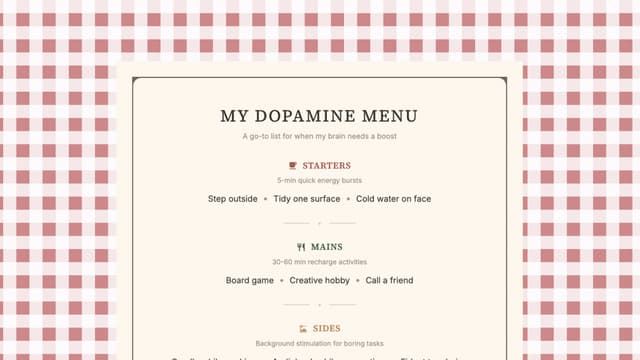
Try the Dopamine Menu
Build your dopamine menu with guided prompts, then get a random suggestion when you're stuck. Free, no account needed. Your menu lives in your browser.
Start this toolUsing it when you're stuck
Having the menu is step one. Using it when you're deep in a dopamine crash is step two, and it's harder than it sounds.
When nothing sounds appealing (and it won't sometimes, that's normal) don't try to find the perfect activity. Go to your Starters, pick the one that sounds least terrible, and commit to two minutes. You're not trying to feel enthusiastic. You're trying to create a micro-shift: just enough dopamine to unstick your brain and make the next decision possible.
If two minutes in, you still feel nothing, that's fine. Try a different Starter. The menu isn't magic. It's a toolkit. Some days you'll need to try a few things before something catches.
The goal isn't to cure boredom or fix your motivation. It's to have something ready so that the next time your brain goes blank, you're not starting from zero.
Tools mentioned in this article
Common questions
About 10–15 minutes if you do it in one sitting. But it's fine to build it over a few days, adding items as they occur to you. The best entries often come to you mid-activity, not during a brainstorming session.
Whichever you'll actually look at. A beautiful notebook on a shelf is less useful than an ugly note pinned to your phone's home screen. Accessibility beats aesthetics.
Start with what you've done in the past week that didn't feel terrible. Scrolling your phone counts. Eating something nice counts. You're not looking for passions. You're looking for things that create any positive shift at all.
Whenever something goes stale or you discover something new. A quick review every few weeks works well. If you notice you're skipping the same items repeatedly, swap them out.
Sources & references
- Dodson, W. (2023). The Interest-Based Nervous System. ADDitude Magazine.
- Barkley, R.A. (2012). Executive Functions: What They Are, How They Work, and Why They Evolved. Guilford Press.