How to Stop Masking ADHD
Unmasking ADHD isn't about dropping all filters. Learn what research says about reducing masking safely, when it protects you, and what actually helps.
If masking harms mental health, the obvious solution is to stop. But it's more complicated than that. Unmasking isn't something you decide to do one day. It's a gradual process with real risks.
The context-switching trap
Research studied three groups: people who masked constantly, people who masked in some contexts but not others, and people who rarely masked.
Here's the surprising finding: both high-masking and "switching" groups had significantly worse mental health than the low-masking group.
Selective masking isn't protective. Being authentic with friends but masking at work doesn't eliminate the cost. The fragmentation itself causes harm.
When you present different versions of yourself in different places, you create identity confusion. Tracking which persona to perform where is its own psychological strain.
This doesn't mean you should unmask everywhere immediately. It means reducing masking needs to be thoughtful rather than random.
The disclosure disconnect
For any identity you're hiding, inconsistent disclosure across life domains damages mental health.
If your partner knows about your ADHD but your employer doesn't, you're managing two realities. If your friends understand but your family thinks you're lazy, you're performing for an audience that changes hourly.
Being out to some people but not others isn't half the burden of hiding everywhere. It may be comparable.
What makes disclosure feel safe: presence of similar others, supportive environment, formal protections. These determine whether unmasking is realistic.
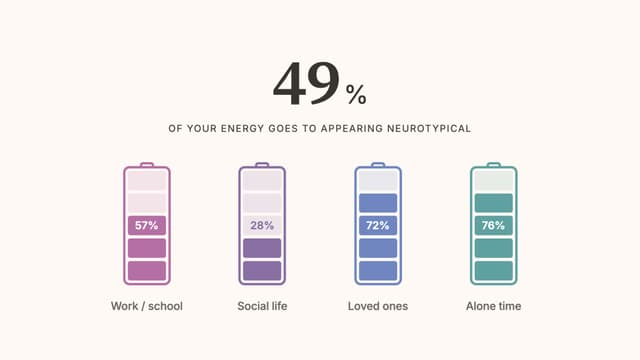
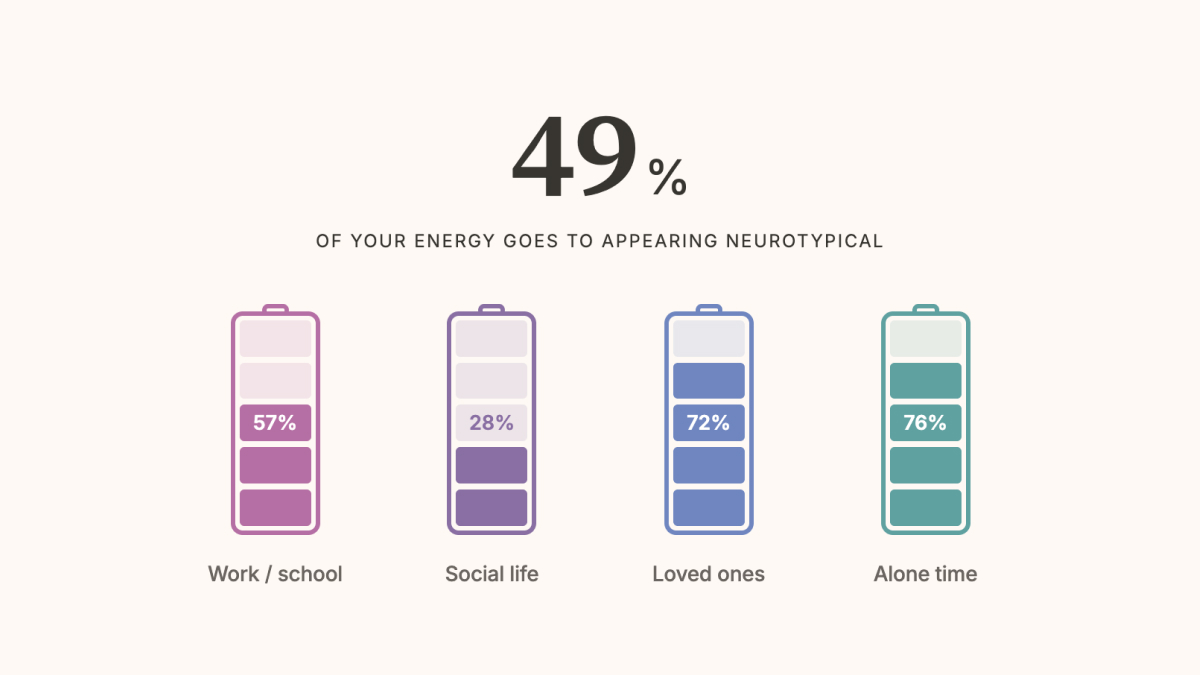
Try the Masking Energy Calculator
See where your energy goes when you're hiding your ADHD. Takes 3-4 minutes.
Start this toolIt's complicated
The only long-term study on this produced results researchers didn't expect.
People with higher initial masking showed a decrease in mental health difficulties over time. Not an increase.
The relationship appears bidirectional. High masking correlates with poor mental health in the moment, but the trajectory is more complex. Some people may be using masking adaptively.
This complicates the simple narrative that masking is purely harmful. For some people, in some contexts, it serves a genuine protective function.
When masking protects you
The stigma is real. Research found 88.5% of ADHD adults anticipated discrimination in daily life. Nearly 72% anticipated discrimination specifically from employers.
A UK survey found 96% of ADHD adults were reluctant to mention their diagnosis at work. Half of hiring managers would hesitate to employ someone from a neurominority group.
In this environment, masking isn't irrational. It's self-preservation.
The goal isn't to unmask everywhere regardless of consequences. It's to identify where masking costs more than it protects.
Strategic unmasking
Research on workplace disclosure found genuinely mixed outcomes. Some people received accommodations and understanding. Others faced stigma and being defined by their diagnosis.
Many adopted selective disclosure based on trust and necessity. This isn't the same as the harmful context-switching described earlier. Strategic unmasking means deliberately expanding where you're authentic.
Start with safe relationships. If you can be unmasked with one person consistently, that's a foundation.
Test low-stakes environments. Disclosing to a new friend carries less risk than disclosing to a hiring manager.
Identify non-negotiables. Which masking behaviours are most exhausting? Which could you drop without significant consequence?
Build neurodivergent community. Research consistently shows people mask less with neurodivergent peers. Finding those spaces reduces overall masking load.
What recovery looks like
Research on burnout recovery found key elements: acceptance, social support, reduced expectations, and unmasking.
Unmasking appeared as part of recovery, not as a standalone fix. It worked alongside support systems, lower demands, and self-acceptance.
People with stronger neurodivergent identity who were openly neurodivergent masked less.
Identity comes first. Disclosure becomes possible when you've accepted yourself. Reduced masking follows from that.
No quick fixes
There are no validated unmasking therapies. Neurodiversity-affirming practitioners incorporate these principles, but we don't have evidence-based protocols yet.
This doesn't mean unmasking doesn't help. It means research hasn't caught up with the concept.
The honest answer
Reducing masking is gradual and strategic. You can't control whether employers discriminate. You can't force family to understand.
What you can control is whether you're draining yourself performing for people who don't reciprocate with acceptance.
Start with one safe person. One context where you're fully yourself. Build from there.
Being unmasked somewhere is better than being partially masked everywhere. And if your current environment offers nowhere safe, changing the environment may be necessary first.
Tools mentioned in this article
Common questions
No. Research shows context-switching masking is just as harmful as constant masking. Strategic unmasking means choosing where to be authentic, not forcing yourself to unmask everywhere.
The relationship is complex. One study found people with higher initial masking actually showed decreased mental health difficulties over time. Unmasking isn't a simple cure.
No validated unmasking interventions exist yet. Neurodiversity-affirming therapists work on identity integration and self-advocacy, but these haven't been tested in controlled trials.
This is a real concern. Most ADHD adults anticipate discrimination. Strategic disclosure (choosing safe people and contexts) respects that risk while reducing masking's cost.
Sources & references
- Cage, E. & Troxell-Whitman, Z. (2019). Understanding the Reasons, Contexts and Costs of Camouflaging for Autistic Adults. Journal of Autism and Developmental Disorders, 49(5), 1899-1911.
- Ragins, B.R. (2008). Disclosure Disconnects. Academy of Management Review, 33(1), 194-215.
- Van der Putten, W.J., et al. (2025). Longitudinal associations between camouflaging and mental health in autistic adults. Autism.
- Masuch, T.V., et al. (2019). Internalized stigma and anticipated discrimination in adults with ADHD. ADHD Attention Deficit and Hyperactivity Disorders, 11(2), 211-220.