What Is a Dopamine Menu? A Guide for ADHD Adults
A dopamine menu is a personalised list of activities organised by effort level. Build it when you have capacity, use it when you're stuck and can't think of options.
A dopamine menu is a personalised list of activities that help you get unstuck, organised by how much time and energy they require. You build it when you have capacity, then reach for it when decision-making feels impossible.
The concept was popularised by Jessica McCabe of How to ADHD and draws on behavioural activation, a clinically validated approach used in treating depression and low motivation. The core insight: when your brain is depleted, it struggles to generate options. But it can still recognise options from a list you made earlier.
Why ADHD brains need a dopamine menu
ADHD brains don't run on importance or deadlines the way neurotypical brains do. Dr William Dodson describes this as the interest-based nervous system: ADHD motivation is driven by novelty, challenge, urgency, and personal interest, not by rational priority.
This means that when nothing triggers those four switches, you get stuck. Not lazy. Not unmotivated. Neurochemically stuck.
PET imaging studies by Volkow and colleagues found that adults with ADHD have significantly lower dopamine receptor availability in reward pathways compared to neurotypical controls. The prefrontal cortex, which handles planning and decision-making, needs dopamine to function. When levels drop, generating options from thin air becomes difficult.
Russell Barkley's research identifies impaired self-motivation as a core feature of ADHD: the inability to internally generate motivation without immediate external reinforcement. The dopamine menu is an external scaffold for this system. It pre-loads rewarding options so your depleted brain doesn't have to generate them from scratch.
Research on decision paralysis in ADHD found that 82% of adults report frequent decision-making difficulties, and 35% experience decision paralysis daily. The menu framework leverages choice architecture: categorising options by effort level reduces cognitive strain. Someone with depleted executive resources can quickly scan "Starters" rather than evaluating every option against their current capacity.
Why the restaurant metaphor works
The menu isn't just a cute framing. It's functional.
A restaurant menu organises food by course: starters, mains, sides, desserts. You don't have to decide what's possible. You scan the options and pick what fits your appetite and budget. The structure does work your brain would otherwise have to do.
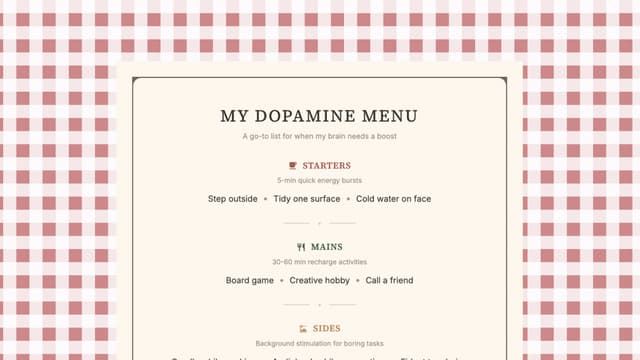
A dopamine menu works the same way. Instead of organising by course, it organises by effort:
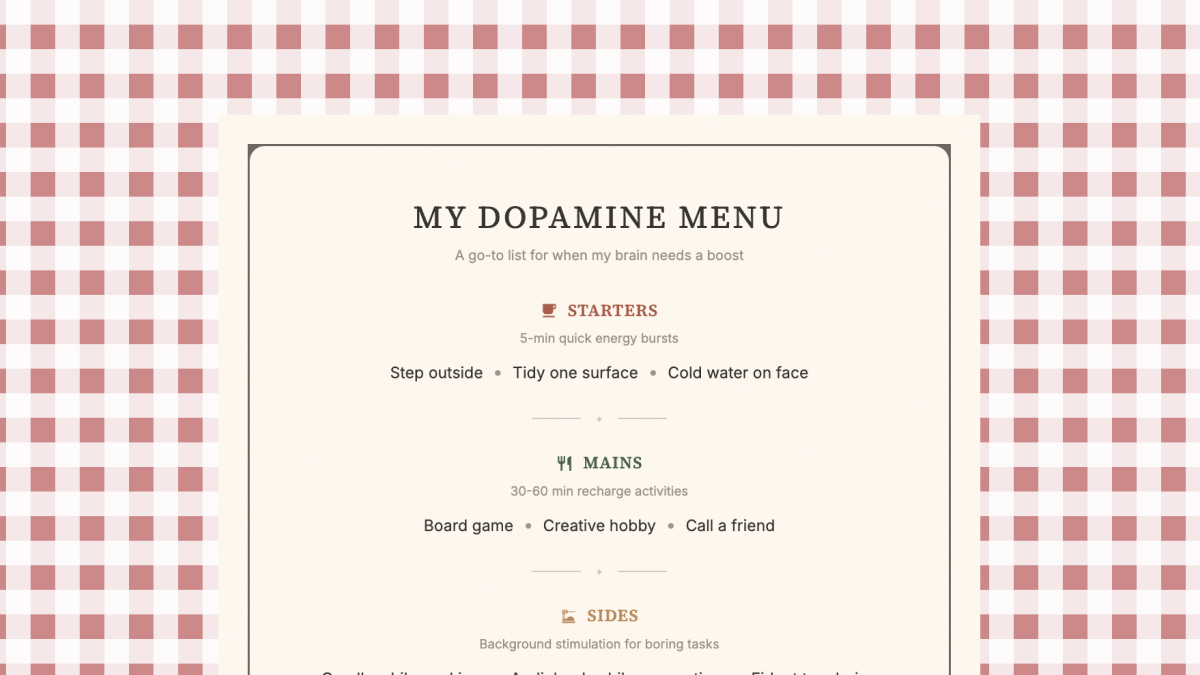
Starters are low-effort, almost-zero-friction activities. Things you can do from the sofa, in under five minutes, without needing to prepare anything. Watching a favourite YouTube channel. Stroking your pet. Scrolling through saved memes. These aren't meant to be transformative. They're meant to create a tiny neurochemical shift that makes the next step possible.
Mains are medium-effort activities that genuinely absorb you. A 20-minute walk. Cooking something you enjoy. Playing a video game. Working on a hobby project. These require some initiation energy but tend to be self-sustaining once you start.
Sides are things you pair with tasks you're avoiding. Background stimulation that makes boring things bearable. Podcast while cleaning, music while cooking, body doubling.
Desserts are high-reward, easy to overdo. No guilt, just awareness. Social media, video games, comfort food. Many people add guardrails like "one episode" or "20 minutes."
Specials are bucket-fillers worth planning for. Having something to look forward to is itself a dopamine source. Concerts, day trips, trying a new restaurant. These go on the menu so you remember they exist, even if you only use them occasionally.
When you're stuck, you don't have to figure out what might help. You look at your menu, check how much time you have, and pick something.
Try the Dopamine Menu
Build your personalised menu in 5-10 minutes. Get a beautiful menu card you can save to your phone.
Start this toolHow to build one that actually works
The best time to build a dopamine menu is when you're not stuck. When you have some capacity, some bandwidth, some clarity. That's when your brain can generate options.
Be honest about what actually works. The most common mistake is filling a dopamine menu with things you think you should enjoy rather than things you actually do. A menu stocked with "go for a run" and "read a non-fiction book" when you actually want "lie on the floor and listen to music" will gather dust. If scrolling Reddit for 5 minutes genuinely helps you reset, that's a valid Starter.
Don't overthink categories. Some activities could fit multiple places. That's fine. Put them where they feel most natural for how you use them.
Keep it scannable. If choosing from the menu feels like its own executive function task, you've defeated the purpose. Aim for a handful of options per category: enough for variety, few enough that scanning them takes seconds.
Keep it alive. Activities lose their dopamine punch over time (novelty decay). If you find yourself skipping over certain items repeatedly, swap them out. A dopamine menu that feels stale becomes homework, not a resource.
When to use it
The dopamine menu isn't for moments when you're already engaged and energised. It's specifically for the gaps: the Sunday afternoon slump, the post-work crash, the weekend morning where nothing sounds appealing but staying in bed feels wrong too.
Keep it somewhere you'll actually see it. Your phone's home screen. A note on the fridge. Pinned in your notes app. The best dopamine menu in the world is useless if you have to remember it exists during the exact moments when your memory is least reliable.
If you're staring at the menu and still can't choose, pick the easiest Starter and commit to two minutes. You're not trying to feel excited. You're trying to break the freeze.
When a menu isn't enough
The dopamine menu works for everyday stuck moments. But it has limits.
If nothing on your menu sounds good, that's valuable information. You might be dealing with sleep debt, burnout, depression, or sensory overload. Issues that go beyond what a menu can solve. It might be time to rest, or to talk to a professional.
The menu is a tool for mild-to-moderate stuck feelings. It's not a treatment for clinical conditions. It won't fix chronic fatigue or major depression. If you're consistently unable to engage with any activities, that's a signal to seek support, not to build a longer menu.
That said, for the everyday "I know I should do something but I can't think of anything" feeling, a well-built dopamine menu can be useful. Not because it's magic, but because it removes one obstacle: the burden of generating options when your brain can't.
Tools mentioned in this article
Common questions
Not quite. Self-care lists are often aspirational (things you should do). A dopamine menu is functional (things you will actually reach for when depleted). The categories help you match activity to available time and energy.
No. Anyone who experiences decision paralysis, low motivation, or the "stuck" feeling can benefit. The menu works because it removes the burden of generating options when your brain is depleted.
There's no magic number, but 15-30 across all categories tends to work well. Enough variety that something always appeals, not so many that choosing becomes its own problem.
That's normal with ADHD. It usually means you're in a dopamine crash, not that your menu is wrong. Pick the lowest-effort item (a Starter) and do it for two minutes. You're not trying to feel excited. You're trying to create a small shift.
A to-do list is obligations. A dopamine menu is options. You're not tracking completion or feeling guilty about skipping items. You're building a set of choices for when you need them.
Sources & references
- Volkow, N. D., et al. (2009). Evaluating dopamine reward pathway in ADHD: Clinical implications. JAMA, 302(10), 1084-1091.
- Barkley, R. A. (2015). Attention-deficit hyperactivity disorder: A handbook for diagnosis and treatment (4th ed.). Guilford Press.
- Marx, I., et al. (2021). ADHD and the choice of small immediate over larger delayed rewards. Journal of Attention Disorders, 25(2), 171-187.
- Dodson, W. (2023). The Interest-Based Nervous System. ADDitude Magazine.
- McCabe, J. (2020). How to give your brain the stimulation it needs. How to ADHD.