What is the ADHD Tax?
The hidden cost of living with ADHD in money, time, and energy. Learn the UK average (£1,600/year) and how to calculate yours.
The ADHD tax is the hidden cost of living with ADHD. The money, time, and energy that drains away not because of choices you've made, but because of how your brain works. Late fees. Impulse purchases. Subscriptions you forgot to cancel. Hours spent searching for things you've lost.
What the ADHD tax includes
The ADHD tax shows up across six main categories:
Impulse spending. That thing you bought at 2am because your brain needed dopamine. The hobby supplies for a hobby you never started. The "treat yourself" purchases that felt urgent in the moment.
Late fees and penalties. Bills paid after the deadline not because you couldn't afford them, but because you forgot, procrastinated, or got overwhelmed by the admin.
Forgotten subscriptions. The gym membership you stopped using months ago. The streaming services you signed up for and never watch. The apps with auto-renewing subscriptions.
Replacement purchases. The third pair of headphones because you lost the first two. The duplicate tools because you couldn't find the one you already own.
Time lost. Hours spent searching for lost items, re-doing tasks because you made ADHD-driven mistakes, recovering from context switches, and managing the chaos that builds up when executive function is compromised.
Energy drain. The constant compensating. The mental load of trying to remember everything. The exhaustion from masking and managing symptoms all day.
Not all of these translate directly to pounds, but they all cost something.
Why ADHD brains pay more
This isn't about being careless or bad with money. It's neurology.
ADHD affects executive function, the brain's management system for planning, prioritising, and impulse control. Russell Barkley's research shows that executive function deficits are central to ADHD, not peripheral symptoms. When your prefrontal cortex works differently, everyday financial tasks become harder.
Thomas Brown's work identifies where this shows up: getting started on tasks, maintaining attention on boring admin, sustaining energy for tedious work, regulating purchases driven by mood, remembering to cancel that subscription, and actually doing what you planned to do.
Time blindness is a core ADHD feature. When your brain can't feel the approaching deadline, late fees become almost inevitable.
The dopamine-seeking that drives impulse purchases isn't greed. It's a neurological system trying to regulate itself. ADHD brains are chronically under-stimulated, and purchasing decisions trigger a dopamine hit that neurotypical brains get from less expensive sources.
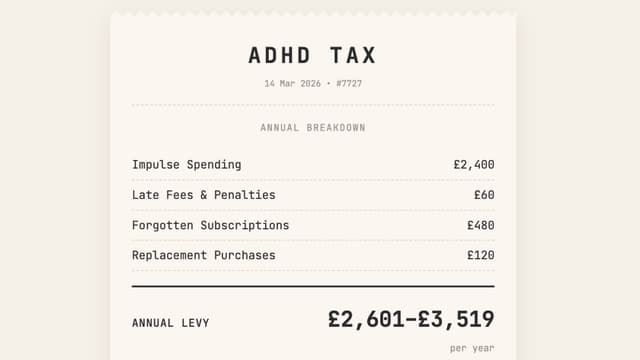
Try the ADHD Tax Calculator
Find out what ADHD actually costs you in money, time, and energy. Takes 3-4 minutes.
Start this toolThe UK average ADHD tax
A June 2022 survey by Monzo and YouGov found that UK adults with ADHD pay approximately £1,600 per year in direct ADHD-related costs. That's money spent on late fees, impulse purchases, forgotten subscriptions, and replacement items.
This figure doesn't include the harder-to-quantify costs: time lost, career impact, relationship strain, or the energy spent compensating for symptoms every day. The true cost is likely much higher.
The £1,600 average also masks significant variation. Some people pay much less because their symptoms are mild, or they've found strategies that work. Others pay significantly more, particularly those diagnosed late, without support systems, or with co-occurring conditions.
Your number isn't a grade or a judgment. It's information. Higher-than-average doesn't mean you're failing; it often means you've been managing without support for a long time.
What to do with your number
Calculating your ADHD tax isn't about guilt. It's about visibility. You can't address something you can't see.
Once you know where your tax is highest, you can make targeted changes. If forgotten subscriptions are costing you hundreds per year, that's a specific problem with specific solutions (subscription trackers, annual payment reviews). If late fees are the biggest drain, automated payments might help more than trying harder to remember.
You won't eliminate your ADHD tax entirely. Some costs are built into having ADHD in a neurotypical world. But you can reduce the unnecessary ones and direct those resources somewhere you actually choose.
Start with the category that's costing you most and where change feels achievable. Small wins build momentum. And knowing the number, seeing what was invisible, is itself a meaningful first step.
Tools mentioned in this article
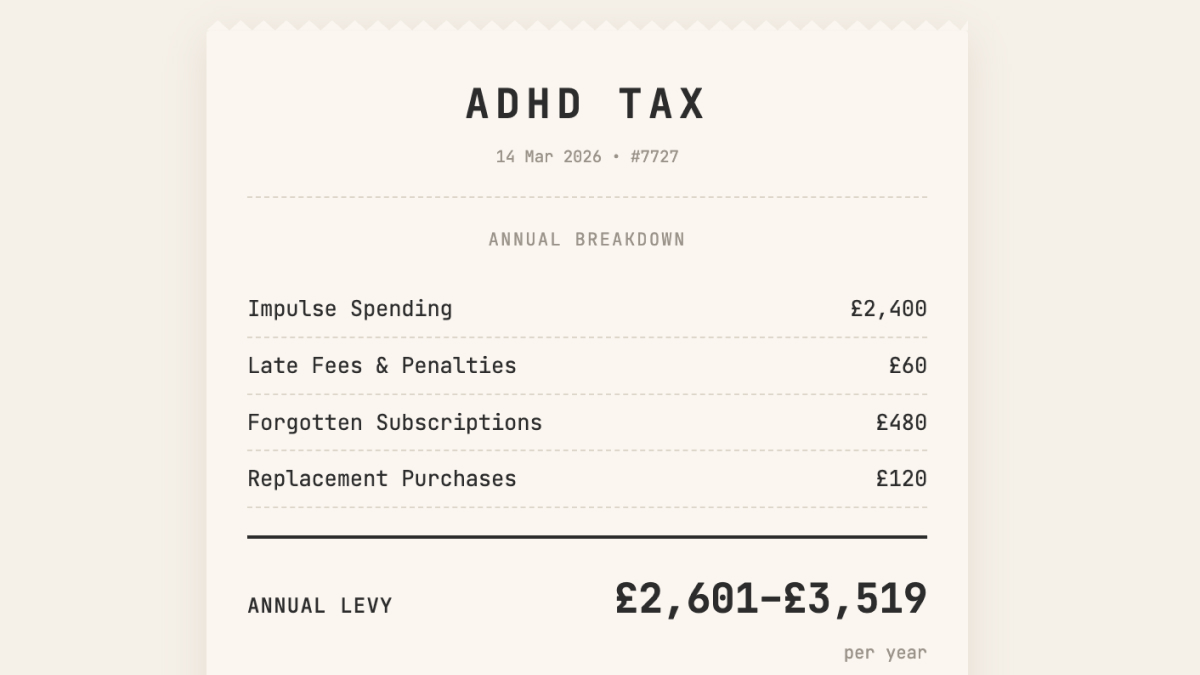
Common questions
It gives you a reasonable estimate using UK averages. Frequency-based questions work better than exact figures because ADHD brains struggle with precise recall.
Energy drain is real but hard to monetise fairly. A stay-at-home parent's drained battery isn't worth £0. The battery level captures the impact without false precision.
Higher-than-average ADHD tax is common, especially for adults who were diagnosed late or haven't had support. The number reflects your condition, not your character.
Yes. Many ADHD-specific strategies can reduce costs. The calculator helps you see where your tax is highest, which shows you where to focus first.
Sources & references
- Monzo/YouGov (2022). The Extra Costs of Living with ADHD. Published 27 June 2022.
- Barkley, R. A. (2012). Executive Functions: What They Are, How They Work, and Why They Evolved. Guilford Press.
- Brown, T. E. (2013). A New Understanding of ADHD in Children and Adults: Executive Function Impairments. Routledge.
- Ahmann, E., Saviet, M., & Tuttle, L. J. (2018). Interventions for ADHD in children and teens: A focus on ADHD coaching. Pediatric Nursing, 44(3), 121-131.