Cognitive Distortions Identifier
Read scenarios. Spot the thinking pattern. Build your radar for 12 cognitive distortions through practice.
Get startedTakes 3-5 minutes · Your data stays on your device
Read scenarios. Spot the thinking pattern. Build your radar for 12 cognitive distortions through practice.
Read a scenario
See a real-world situation and the automatic thought it triggers
Spot the pattern
Choose which of 4 thinking patterns best fits the thought
Build your radar
Get feedback and track which distortions you're getting better at spotting
The Cognitive Distortions Identifier helps you practice spotting unhelpful thinking patterns through real-world scenarios. Instead of reading a list and hoping you'll remember it, you build pattern recognition through active practice.
Cognitive distortions are mental shortcuts that bend reality in unhelpful ways. First identified in Cognitive Behavioral Therapy, these patterns can fuel anxiety, depression, and stress by making situations seem worse than they are. Everyone has them. The skill is noticing when they're running.
The tool shows you a scenario (something that might happen at work, in a relationship, or in daily life) along with an automatic thought that follows. Your job is to identify which thinking pattern is at play. You get immediate feedback explaining why each option fits or doesn't.
The more you practice, the easier it becomes to catch these patterns in your own thinking. Not to judge yourself, but to notice when your brain is bending reality.
Once you can spot a distortion, you can question it. "I'm catastrophising" is different from "This is definitely going to be a disaster." The first gives you distance. The second runs you. That's the skill this tool builds: not positive thinking, but accurate thinking.
All-or-Nothing Thinking
Seeing things as entirely good or entirely bad
Overgeneralisation
Taking one event and turning it into a permanent rule
Mental Filter
Focusing only on negatives while filtering out positives
Disqualifying the Positive
Dismissing good things as flukes or "not counting"
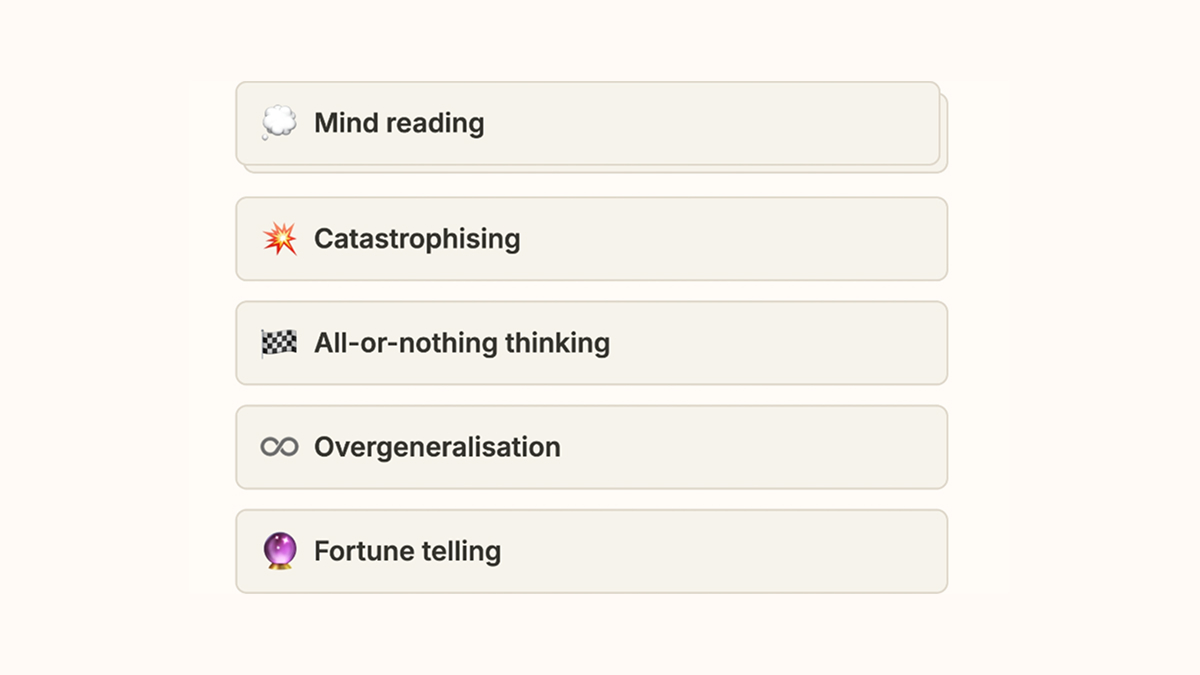
Mind Reading
Assuming you know what others think without evidence
Fortune Telling
Predicting the future will be negative without justification
Catastrophising
Blowing things out of proportion, jumping to worst-case scenarios
Emotional Reasoning
Assuming that because you feel it, it must be true
Should Statements
Rigid rules about how you or others "should" behave
Labelling
Putting a fixed negative label on yourself or others
Personalisation
Blaming yourself for things outside your control
Blame
Holding others entirely responsible for your emotional pain
This tool is for anyone who wants to get better at noticing their own thinking patterns. That includes people managing anxiety or depression, people in therapy who want to practice CBT skills between sessions, and neurodivergent folks who experience rejection sensitivity or emotional flooding. You don't need a diagnosis or a therapist to use it. Just curiosity about how your mind works.
Cognitive distortions were first systematically identified by Aaron Beck in his foundational work on cognitive therapy in the 1960s. His research showed that depression and anxiety are often maintained by characteristic patterns of distorted thinking: systematic errors in reasoning that make situations seem worse than they are.
David Burns popularized these patterns in Feeling Good (1980), expanding Beck's categories into the 12 distortions used in this tool. Research has consistently shown that learning to identify these patterns is a key mechanism of change in CBT, one of the most extensively studied and effective forms of psychotherapy.
This tool uses elaborated feedback, which research shows is more effective for learning than simple right/wrong responses. When you see why each option does or doesn't fit, you build deeper understanding than just memorizing definitions.
The scenarios draw from common life domains (work, relationships, health, and daily situations) because distortions are context-dependent. Practicing across multiple contexts helps you recognize patterns wherever they show up.
Pattern recognition is a skill that improves with practice. Studies on perceptual learning show that repeated exposure with feedback leads to automatic recognition over time. The goal isn't to eliminate these patterns (everyone has them) but to notice when they're running so you can question them.
That's part of learning. The feedback explains why each option does or doesn't fit, so 'wrong' answers teach you something. There's no score to worry about, just practice.
Often, yes. Real thoughts can involve multiple patterns. The tool identifies the primary distortion and notes when alternatives also apply. Life is messier than clean categories.
Weekly practice builds recognition over time. Some people do a quick session when they notice their mood dipping. There's no right frequency. Whatever helps you notice patterns is working.
That's the goal. Practicing on external scenarios builds the pattern recognition you need to catch distortions in your own thinking. Many people report noticing their patterns more after a few sessions.
No. This is a practice tool, not treatment. If you're struggling with persistent anxiety, depression, or distressing thoughts, working with a therapist trained in CBT can help you apply these skills to your specific situation.
Some patterns overlap (like fortune telling and catastrophising), and some depend on subtle context. The feedback helps you see the distinctions. Difficulty with certain patterns is useful information about where to focus.