Values Compass
See 4 values at a time. Pick most and least. Repeat 12 times. Get a compass showing what drives you, from core values to background noise.
Get startedTakes under 2 minutes · Your data stays on your device
See 4 values at a time. Pick most and least. Repeat 12 times. Get a compass showing what drives you, from core values to background noise.
Pick most and least
See 4 values. Tap the one that feels most like you, then the one that feels least.
Repeat 12 times
Go with your gut reactions. No deliberation needed. Takes under 2 minutes.
See your compass
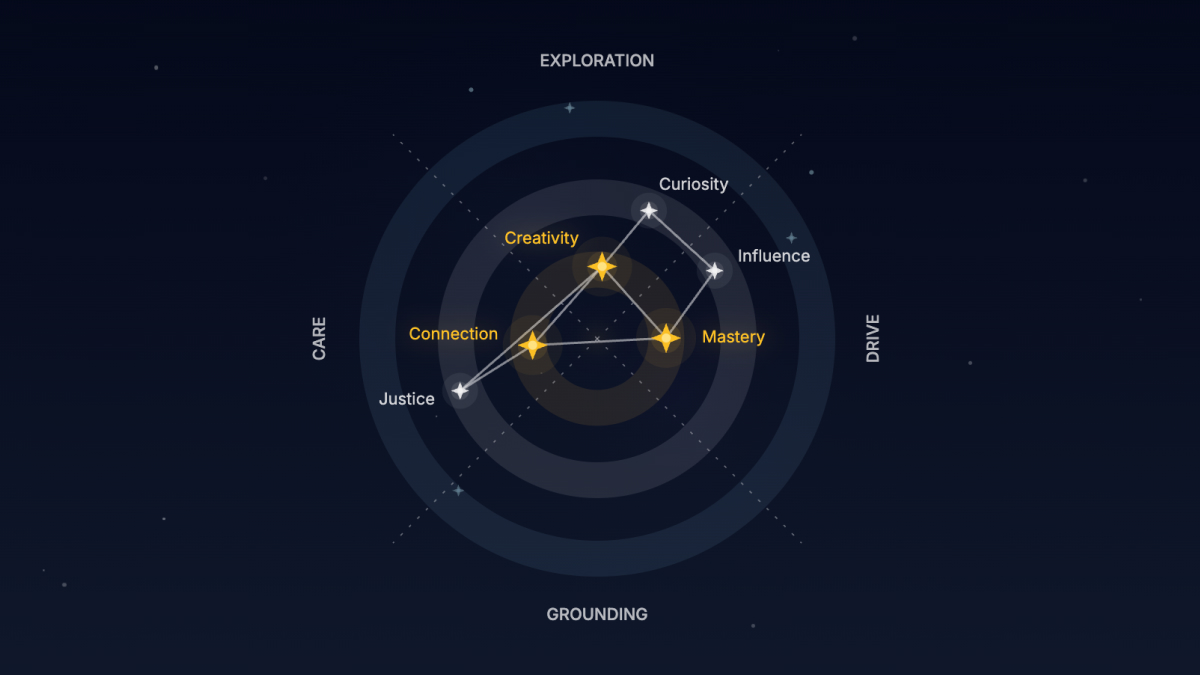
Your compass shows what's at your core, in orbit, on the horizon, or in the background.
The Values Compass is a visual self-assessment tool that helps you identify your core values in under 2 minutes using a proven method called Best-Worst Scaling.
Unlike traditional values exercises that hand you a long list and ask you to rank everything at once, this tool shows you just 4 values at a time and asks two simple questions: Which feels most like you? Which feels least like you?
You'll do this 12 times. About 5 seconds per screen. Each value is described as a concrete behavior, not an abstract word. "Follow my interest into new topics and let them take me somewhere unexpected" instead of just "Curiosity."
The result isn't a ranked list or percentages. It's a compass with four tiers that shows what's steering you right now: Core (your north stars), Orbit (consistently important), Horizon (present but not primary), and Background (not steering you today).
This tool is for anyone who wants clarity on what actually matters to them right now. That includes people facing decisions (career moves, relationship changes, time commitments), people in therapy or coaching who want to ground their work in personal values, and anyone who feels disconnected from what they care about. It's especially useful for people who find traditional values lists overwhelming or abstract.
The Values Compass uses Best-Worst Scaling (BWS), a method from market research and psychology that produces clearer preference rankings than traditional rating scales. When you ask people to rate everything, they tend to say most things are "important". Results become mushy. BWS solves this by forcing choices between specific options.
Each screen showing 4 values generates multiple implied comparisons between pairs. Twelve screens create approximately 60 implied comparisons, enough to produce a reliable ranking from just a couple minutes of choices. This efficiency is why BWS is used in consumer research, healthcare decisions, and psychological assessment.
The method works because choosing extremes (most/least) is cognitively easier than rating or ranking. You can quickly identify what feels most and least like you, even when the middle options blur together. This makes the assessment faster and more intuitive.
The behavioral descriptions draw from Acceptance and Commitment Therapy (ACT) principles. ACT research shows that describing values as concrete actions rather than abstract concepts helps people connect with what genuinely matters to them, rather than choosing words that sound socially desirable.
The four-tier compass structure (Core, Orbit, Horizon, Background) reflects how people naturally understand priorities in categories rather than continuous scales. This makes results easier to grasp and act on than a ranked list of 16 numbers.
Most values tools ask you to rate or rank a long list all at once. This uses Best-Worst Scaling, a proven method that shows you 4 values at a time and asks which feels most and least like you. It's faster, more accurate, and harder to game.
Abstract words like 'Growth' or 'Connection' mean different things to different people. Behavioral descriptions ('Share what I'm learning with people who are curious about the same things') make choices clearer and results more honest.
That's normal. Your compass reflects this season of your life. Values aren't fixed. They shift as you grow. Retake it in 3-6 months and compare.
Not at all. Background doesn't mean unimportant. It means not steering you right now. That's useful information, not a judgment.
Best-Worst Scaling research shows that 12-18 questions generate enough implied comparisons (around 60) to rank 16 items reliably. It's designed to be fast and accurate.
Yes. Your core values can guide tough choices like career moves, relationships, and time commitments. If a decision aligns with your core, it'll feel right. If it conflicts, that's why it feels hard.
Your data stays on your device. Nothing is saved to a server. Screenshot your compass if you want to keep it or share it with a coach or therapist.