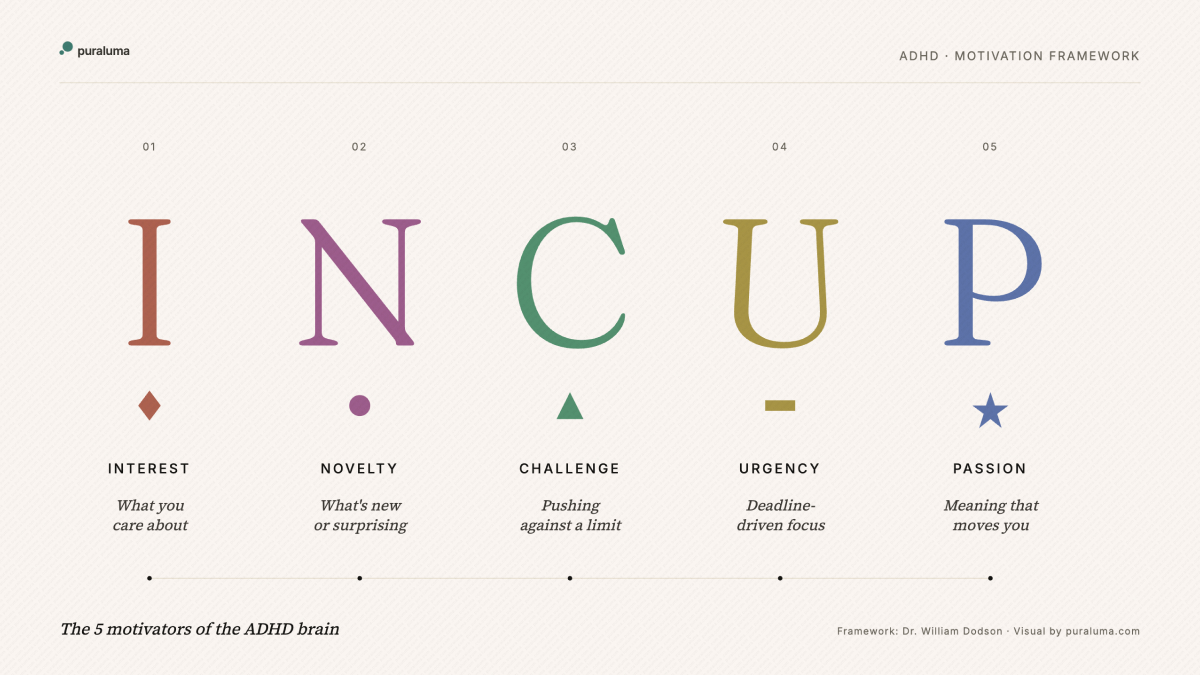
INCUP — The 5 motivators of the ADHD brain: Interest, Novelty, Challenge, Urgency, Passion
Download
INCUP: The 5 motivators of the ADHD brainA five-column reference slide showing Interest, Novelty, Challenge, Urgency, and Passion as the five conditions that activate the ADHD interest-based nervous system.puralumaADHD · MOTIVATION FRAMEWORK0102030405INCUPINTERESTNOVELTYCHALLENGEURGENCYPASSIONWhat youcare aboutWhat's newor surprisingPushingagainst a limitDeadline-driven focusMeaning thatmoves youThe 5 motivators of the ADHD brainFramework: Dr. William Dodson · Visual by puraluma.com
ADHD · Motivation framework · Reference

INCUP: The 5 motivators of the ADHD brain.

Interest. Novelty. Challenge. Urgency. Passion. The five conditions that reliably activate focus in an ADHD nervous system, not willpower, but fuel.

Framework: Dr. William Dodson · Visual by puraluma.com

00 · TL;DR

If a task doesn’t touch interest, novelty, challenge, urgency, or passion, an ADHD brain can know it matters and still struggle to start. INCUP is the map of what actually turns the engine over.

01 · Definition

What is INCUP?

INCUP is an acronym for Interest, Novelty, Challenge, Urgency, and Passion — the five conditions that reliably activate focus in an ADHD brain. It was coined by Dr. William Dodson, a psychiatrist who spent more than twenty-five years specialising in adult ADHD, and it sits on top of a broader idea he popularised: the interest-based nervous system.

Most productivity advice is written for an importance-based nervous system. That brain runs on stakes: deadlines, consequences, duty, long-term payoff. It can push itself toward a task simply because the task matters. An interest-based nervous system does not work like that. It runs on engagement. Importance alone is not fuel. The task has to touch one of the five levers, or the engine does not turn over- regardless of how much the person wants it to.

That is the whole insight. Not a moral failing. Not a motivation deficit. A different fuel mix.

If you could get engaged and stay engaged, has there ever been anything you couldn’t do?Dr. William Dodson, to his ADHD clients
02 · The Five

The five motivators, one by one

01

I

InterestWhat you actually care about

Interest is the purest form of fuel. When a task touches something a person is genuinely curious about, the brain stops needing to be convinced. It leans in on its own. The mistake is to think interest is fixed. In practice it can often be recruited by connecting a dull task to a subject, a person, or a question that already lights the person up.

In a session - Ask the client what part of this task, if any, is interesting to them. If the answer is "none of it," ask what a more interesting version of it would look like.
02

N

NoveltyWhat's new, different, or surprising

Novelty is a dopamine shortcut. The brain reacts to change itself regardless of whether the underlying task is familiar, which is why a task can feel impossible at the kitchen table and straightforward in a café. It is also why routines tend to decay: once a strategy stops being new, it stops activating the brain that needed it.

In a session - Change one variable on the next attempt: location, time of day, the tool being used, or the order of steps. Not all of them. Just one.

03

C

ChallengePushing against a real limit

Challenge is difficulty with a heartbeat: a clear win condition, a visible limit, some way to know whether you beat it. Games are the clearest example, but the same mechanism activates around a timer, a word count, a streak, or a side-by-side with another person. The ADHD brain often cannot get started on a vague task and then easily gets started on an arbitrarily harder version of the same task, once that version has edges.

In a session - Turn the task into a specific, measurable bet. "Can I draft this in thirty minutes?" beats "I should work on this."

04

U

UrgencyDeadline-driven focus

Urgency is the one most ADHD adults recognise first, because they have been running on it by accident for years. A real deadline produces a spike of focus that abstract importance never will. The catch is that the brain can't tell the difference between a genuine deadline and a convincing one. That's both the problem and the leverage point: artificial urgency (a timer, a commitment to another person, a scheduled block) can do the same work without the crash.

In a session - Name a time by which the next concrete step will be done, out loud, to someone else. Precision and a witness both matter.

05

P

PassionMeaning that actually moves you

Passion is the slow-burning version of interest: a connection to a larger sense of why this matters, to this particular person, in this particular life. It is the motivator that carries a task through the middle, after novelty has worn off and before the deadline arrives. It is also the motivator most often missing from to-do lists written in a hurry, which is one of the reasons those lists quietly fail.

In a session - Ask what this task, completed, makes possible. Not what it produces, but what it unlocks. Write the answer next to the task.

03 · Context

Interest-based vs. importance-based

INCUP only makes sense against the broader shift Dodson proposed: that the ADHD brain doesn’t run on the same fuel as the neurotypical brain. Most advice assumes the first column. The second column is the one INCUP is written for.

Neurotypical

Importance-based nervous system

ADHD

Interest-based nervous system

Motivated by stakes: deadlines, consequences, duty, reward
Motivated by engagement: interest, novelty, challenge, urgency, passion
"This matters" is often enough fuel to begin
"This matters" is rarely enough fuel on its own
Willpower and discipline act as reliable bridges
Dopamine, not willpower, is the currency
To-do lists and priority-ranking work as intended
Lists work only when items already touch INCUP
Urgency generates stress that can block action
Urgency can generate focus rather than block it
04 · Use

How to actually use INCUP

INCUP is a diagnostic before it is a prescription. The first move is always the same: look at the task that isn’t happening and ask which of the five, if any, it touches. If the answer is none, that’s the finding. Motivation isn’t missing- the task is simply stripped of every lever that would activate this brain.

01

Name the stuck task

Pick one specific task that keeps not happening. Not a category ("admin") but a task ("file the Q3 expense report"). INCUP works on the concrete, not the abstract.

02

Score it against the five

Go through I, N, C, U, P one at a time. Does this task, as currently framed, touch any of them? Be honest. A task that scores zero is a task that will not start on willpower alone.

03

Add one lever, not five

Pick the single easiest lever to add and add only that one. A timer, a companion, a location change, a stake. One change. Re-attempt. Adjust. The goal is a working fuel mix, not a perfect one.

05 · Nuance

When INCUP helps and when it doesn’t

Where it shines. Task initiation. Procrastination on boring-but-necessary work. Post-diagnosis sense-making: INCUP tends to be one of the first frameworks that makes a lifetime of confusing experience finally make sense. It is also genuinely useful in coaching sessions because it gives a shared language: you stop arguing about discipline and start designing fuel.

Where it’s not the right tool. INCUP is not a treatment. It does not replace medication, therapy, or a clinical assessment. It does not address emotional dysregulation, rejection-sensitive dysphoria, sleep debt, or burnout, all of which can mimic motivation problems and none of which will respond to “add a timer.” The framework was also developed in clinical practice, not validated in randomised trials. Treat it as a working model that explains a great deal, not as a diagnosis or a science-settled law.

The failure mode to watch for. INCUP can quietly become a new kind of pressure: “why can’t I even make this interesting?” If the client starts using the framework to judge themselves for not engineering their own dopamine hard enough, that’s the signal to put it down for a bit.

06 · FAQ

Common questions

The INCUP framework was coined by Dr. William Dodson, an American psychiatrist who spent over twenty-five years specialising in adult ADHD. It grew out of his broader concept of the interest-based nervous system, which he developed to explain why his adult ADHD patients could focus brilliantly in some conditions and not at all in others.

They describe the same underlying idea. INCUP (Interest, Novelty, Challenge, Urgency, Passion) is Dodson's original acronym. PINCH is a later reframing, most often attributed to Dr. Megan Anna Neff, that swaps in Play/Pressure for Passion and Hurry/Humor for Urgency. Different clinicians expand PINCH differently, which is part of why we use INCUP here: one stable definition, one clear source.

No. It means willpower alone is an unreliable fuel for an ADHD brain, which is not the same thing. INCUP offers five fuels that work more dependably with ADHD neurology, so the brain is not being asked to brute-force what it isn't wired to do on demand. Discipline still matters. It's just easier to exercise once the task actually hooks into the nervous system.

INCUP is a clinically-derived framework, not a randomised-trial outcome. It sits on top of well-established research on dopamine signalling, reward, and attention in ADHD. Take it as a working model that maps neatly onto lived experience and a growing body of neuroscience, not as a diagnostic tool or a settled scientific law.

Yes, that's exactly what this page is for. Screen-share the image, download it to include in your own notes, or send the page link after a session so the client has a reference. We just ask that the framework stays attributed to Dr. Dodson and the visual to Puraluma.

07 · Sources

Sources & further reading

  1. Dodson, W. (n.d.). ADHD and the Interest-Based Nervous System. ADDitude Magazine. A foundational overview of the interest-based nervous system and the INCUP motivators, written by the clinician who coined the framework.
  2. Faraone, S. V., et al. (2021). The World Federation of ADHD International Consensus Statement: 208 Evidence-based conclusions about the disorder. Neuroscience & Biobehavioral Reviews, 128, 789–818.
  3. Volkow, N. D., et al. (2011). Motivation deficit in ADHD is associated with dysfunction of the dopamine reward pathway. Molecular Psychiatry, 16(11), 1147–1154. Neuroscience grounding for why interest, novelty, and urgency reliably recruit ADHD focus.
  4. Barkley, R. A. (2015). Attention-Deficit Hyperactivity Disorder: A Handbook for Diagnosis and Treatment (4th ed.). Guilford Press. Chapter discussions on executive function, motivation, and self-regulation that provide context for interest-based models.
  5. Neff, M. A. (n.d.). The Interest-Based Nervous System. Neurodivergent Insights. A contemporary reframing of the concept, including the PINCH variation.