🛠️
Pick what helps
Browse 6 tiredness types. Tap up to 3 rest options per type. Skip any category that doesn't fit.
Get your rest menu
Download a card with your picks, organised by kind of tired. Save it to your phone or print it.
Reach for it when you're fried
Next time you're scrolling instead of resting, open your menu. One glance, one pick, no decisions.
A rest menu is a personalised list of rest options organised by the kind of tired you are. Not a generic self-care checklist. Not "have you tried yoga." A menu you build when you have capacity, so future-you can reach for it when present-you is fried and scrolling instead of resting.
The concept draws on Saundra Dalton-Smith's tiredness types for its categories and Sabine Sonnentag's recovery research for the underlying principle: different kinds of depletion need different kinds of recovery. Relaxation, psychological detachment, mastery, and control are distinct recovery experiences, not interchangeable.
This tool organises rest into six categories, each framed as a symptom rather than a label:
What makes this version different: most rest advice assumes stillness. ADHD brains often need stimulation to rest, not silence. The menu defaults to active rest ("cook something simple," "potter with your hands," "shake it out") and uses symptom descriptions instead of clinical labels, so you can point at the one that fits without needing to name exactly what you're feeling.
This tool is for anyone who scrolls instead of resting when they're depleted. That includes people with ADHD, autistic burnout, depression, or chronic fatigue. It's especially useful if you feel guilty about resting, can't tell what kind of tired you are, or find that "just relax" makes things worse. You don't need a diagnosis to benefit from having the right rest options ready before you need them.
The rest menu is built on a counterintuitive finding: for ADHD brains, doing nothing is often the least restful option. PET imaging by Volkow and colleagues (2009) found that adults with ADHD have lower dopamine receptor availability in reward pathways, creating a chronic understimulation that silence amplifies. Antrop and colleagues (2000) tested this directly: children with ADHD became more hyperactive in unstimulating environments, but their behaviour normalised when given stimulation. Zentall's optimal stimulation theory (1975) explains why: what looks like restlessness is the brain self-regulating upward toward a workable baseline.
This connects to a second finding. Sidlauskaite and colleagues (2016) studied default mode network activity in ADHD adults and found "attenuated DMN up-regulation when anticipating switches back to rest," suggesting the ADHD brain has measurable difficulty initiating rest states. A pre-built menu bypasses this by externalising the transition: instead of generating options from a depleted brain, you recognise one from a list.
A third challenge is naming the tiredness itself. Kinnaird, Stewart and Tchanturia's meta-analysis (2019) found that roughly half of autistic adults meet alexithymia criteria, meaning difficulty identifying internal states. Bruton and colleagues (2025) found similar interoceptive challenges in ADHD. The tool addresses this by framing categories as symptoms ("if your head's full") rather than asking you to label what's wrong.
The category structure itself draws on Sonnentag and Fritz's Recovery Experience Questionnaire (2007), which identifies detachment, relaxation, mastery, and control as distinct recovery dimensions. Different activities restore different things. A walk provides detachment. A hobby provides mastery. Knowing which you need is the difference between resting and just stopping.
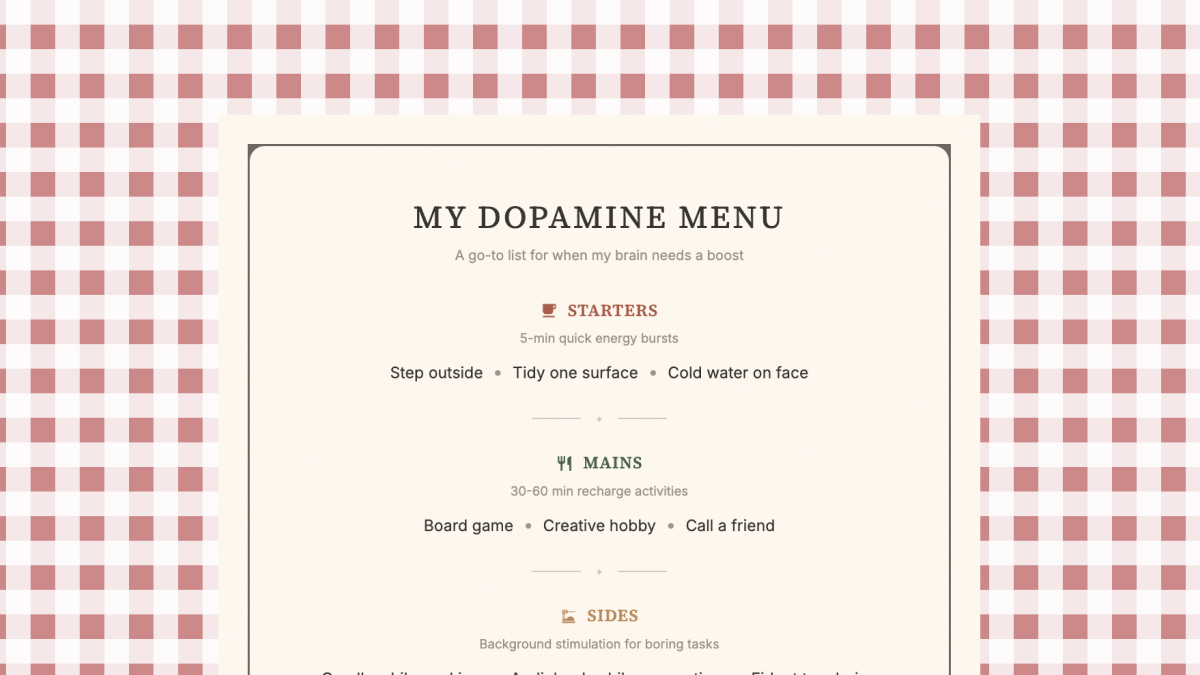
A dopamine menu is for getting unstuck (motivation). A rest menu is for getting restored (replenishment). One fills the tank, the other changes the fuel type. They complement each other.
That's common, especially with ADHD. Each category starts with a symptom description, not a clinical label. If nothing clicks, pick the one whose description sounds closest, or try one at random. The menu works even without perfect self-diagnosis.
No. ADHD research shows the brain has measurable difficulty initiating rest states. A menu isn't a crutch. It's an external scaffold for a system that works differently, like glasses for eyes that focus differently.
That's valuable information. If rest options aren't landing, you might be dealing with something beyond everyday tiredness: sleep debt, burnout, depression, or medical fatigue. The menu works for everyday depletion, not crisis states. Talk to someone if it persists.
Fewer options means easier scanning when you're fried. A menu with 20 items becomes another wall of text you'll scroll past. Three is enough to have a real choice without decision fatigue.
When items stop landing. Rest needs shift with seasons, life changes, and capacity. Some people update quarterly; some keep the same menu for a year. If you're scrolling past your menu instead of using it, it's time for a fresh one.
Yes. The menu card is designed to share. Some coaches use it as a starting point for rest and recovery conversations. The categories can surface patterns you haven't named yet.