ADHD Wheel of Life
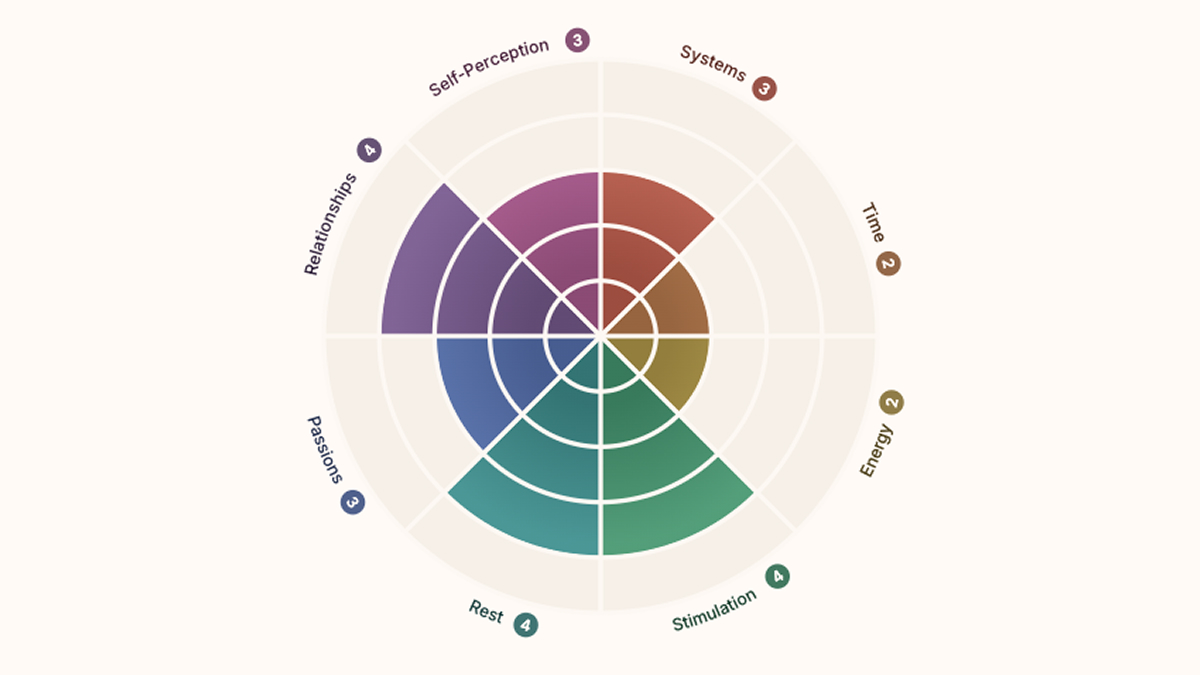
Rate 8 ADHD-specific life areas. See your balance as a visual wheel. Spot imbalances instantly.
Get startedTakes 3-5 minutes · Your data stays on your device
Rate 8 ADHD-specific life areas. See your balance as a visual wheel. Spot imbalances instantly.
Rate your areas
Score 8 life areas on a simple scale with ADHD-specific questions
Watch pattern emerge
See your balance visualized in real-time as a colorful wheel
Get insights
Discover patterns and areas to focus on based on your scores
The ADHD Wheel of Life is a visual self-assessment tool that helps you rate satisfaction across 8 life areas specifically affected by ADHD neurobiology, then displays your results as a radar chart so you can spot imbalances instantly.
Unlike the traditional Wheel of Life (which asks you to rate generic categories like "career" or "finance"), this version focuses on what actually matters for ADHD brains: executive function, energy management, time perception, stimulation needs, and rest.
You rate 8 areas (systems, energy, focus, time, body, stimulation, connection, and purpose) and see your pattern as a radar chart. An uneven wheel shows you exactly where the imbalances are.
Research shows ADHD brains process visual information faster than text. Instead of holding 8 numbers in your head, you see the whole picture at once. That's why the wheel works.
This tool is for anyone who wants to check in on their life balance through an ADHD-informed lens. That includes people with ADHD (diagnosed or self-identified), people exploring whether ADHD might explain their experience, and anyone who finds traditional life balance assessments don't quite fit. You don't need a diagnosis to use it. If the categories resonate, it's for you.
The ADHD Wheel of Life adapts the traditional coaching tool to reflect the lived experience of ADHD brains. Research shows that standard life balance assessments often miss the specific challenges neurodivergent people face: executive function, time blindness, stimulation needs, and energy management aren't captured in generic categories like "career" or "finance."
This tool draws from ADHD research on executive function, emotional regulation, and dopamine-seeking behavior. Studies by Russell Barkley and Thomas Brown emphasize that ADHD is fundamentally about self-regulation across multiple domains, not just attention. The eight categories map to the areas most affected by ADHD neurobiology.
The categories reflect findings from ADHD coaching research. A 2016 study in the Journal of Attention Disorders found that ADHD coaching is most effective when it addresses concrete skill-building in areas like time management, organization, and emotional regulation: exactly what these categories target.
The visual format is particularly effective for ADHD brains. Research on working memory deficits in ADHD shows that visual representations reduce cognitive load and make patterns immediately visible. Rather than tracking eight numbers in your head, you see the whole picture at once.
What makes this ADHD-specific is the focus on regulation rather than achievement. You're not rating "career success". You're rating whether your systems are working, whether you're getting enough rest, and whether your brain is getting the stimulation it needs. That shift from external metrics to internal regulation is central to ADHD-informed coaching.
The categories are ADHD-specific. Instead of generic areas like 'career' or 'finance,' this version focuses on executive function, energy management, stimulation needs, rest, and time perception: the areas most affected by ADHD neurobiology.
No. If the categories resonate with your experience, the tool is for you. Many people find it useful before diagnosis, during the diagnostic process, or just as a neurodivergent-friendly way to check in with themselves.
Not at all. That's really common, especially during burnout or transitions. The tool isn't meant to shame you. It's meant to help you notice patterns and choose one area to focus on first. Small improvements cascade.
That's valuable information. It might mean you're in burnout, that your support systems aren't working, or that you're being too hard on yourself. Consider focusing on rest and energy first. Those are the foundation for everything else.
Probably not. A 5 means optimal functioning, which is unrealistic to maintain across all areas. Most people find that 3-4s feel sustainable and good. The goal is progress, not perfection.
Absolutely. Some people prefer the ADHD version for personal reflection and the traditional version for contexts where they're explaining their life balance to others (like therapists or coaches).
Monthly works well for tracking patterns. Some people prefer weekly during high-stress periods or quarterly for bigger-picture reflection. Let your intuition guide you.